It’s been exciting to see how much roguelites have evolved over the years. Indeed, the very special ones have reached that enviable sweet spot where they effectively maintain that engaging gameplay loop while also incorporating other aspects to provide a unique experience. That’s exactly what Daimon Blades does. It boasts excellent first-person hack-and-slash combat with deep progression systems, but also sprinkles in some roguelite mechanics to give players plenty of replayability. Even if Daimon Blades still has some of that early access jank and could benefit from better explanations and onboarding, it’s still a pretty engaging game, and one that will provide players with brutal first-person action.
A Daimon Inside the Blade
I got the chance to try the early access build of Daimon Blades for some time, and I must say that I was mostly pleased with everything that it had. It is important to keep in mind that it still has that early access feel and a few missing systems and QoL features here and there, but overall, it was pretty enjoyable.
Daimon Blades puts you in the heavy boots of any of the knights destined to stop The Hermit, your old mentor. To do so, you’ll have to go through different procedurally-generated maps, cut a few demons in half, and face a few bosses. To help you cut these demon horde down, you’ll get your trusty and talkative weapons, each one infused with a Daimon who will sometimes diss you, throw in a few witty remarks, and play with you as you go deeper into your run. They are also part of the gameplay, as each Daimon provides different buffs to your weapon once you level it up.
In truth, it was nice to see a roguelite take a more first-person melee approach and leave guns on the side, especially since Daimon Blades nails the swordplay. There were several weapons to try, but I went with my Sword and Shield, and loved every second of it. Attacks are responsive, collision effects are superb, and every button you press to slice a demon gives you the same satisfaction as parrying an attack in DOOM: The Dark Ages.
Each weapon has its own light combo and then a heavy attack that you can execute by holding the attack button. On top of that, there’s a ranged ability that changes depending on the weapon and skills you have, such as the Sword and Shield launching a sphere-like projectile, and in other cases, becoming a shotgun-like blast. You can also charge ranged attacks to deal more damage to enemies.
Beyond that, there’s also Alchemy, which are abilities you can equip during your run with a variety of effects, such as healing everyone in the group or creating a tornado to suck enemies in and damage them. I often found myself spamming my normal attacks more, as the gore and first-person brutality were quite satisfying, but it was nice to see a variety of abilities that you and other teammates can use.
Furthermore, there are a lot of things you can collect during your runs to unlock the forge, complete quests, and give your character permanent upgrades. While I’ll dive deeper into the whole roguelite aspect in a bit, I must say that, despite the top-notch combat, world-building, and visuals, Daimon Blades needs a way to explain things more clearly. I had a few quests that required me to get certain items, but I didn’t find a way to see how many of the necessary items I had. Also, the UI, while great in some ways, can be a bit overwhelming and hard to follow, especially if you’re looking at the vast skill tree or some of your permanent upgrades.
Still, since this was an early access build, I was more than capable of looking past that, especially since the core gameplay loop of Daimon Blades is pretty promising. Yet, I hope the studio works on fixing these things to make the game even more approachable and easier to understand.
Another Hellish Expedition
You will do most of your demon-hunting in any of the procedurally-generated maps of Daimon Blades. Once you have your equipment ready, you can launch an expedition from the hub that will take you to a different zone. Each of these areas has a different layout every time, and they even have a few things you can find, such as human sacrifices to heal you, materials nodes to gather, and more.
To my surprise, there was plenty of enemy variety, with each foe providing a different challenge. For instance, there are a few spider-like creatures that you can only hit with ranged moves, demons with heavy shields that require you to cast your ultimate skill or stagger them first, and a few angel-like foes that launch heavy AoE moves that can only be dodged or blocked. I’ve always thought that enemy variety is the spice of any game, and Daimon Blades provides a lot, which makes every run feel more unique.
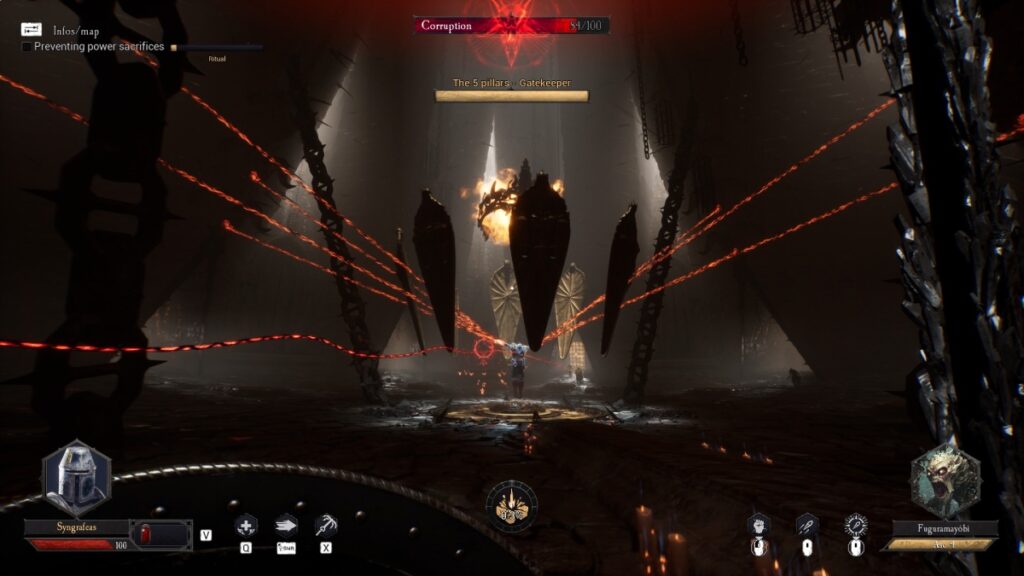
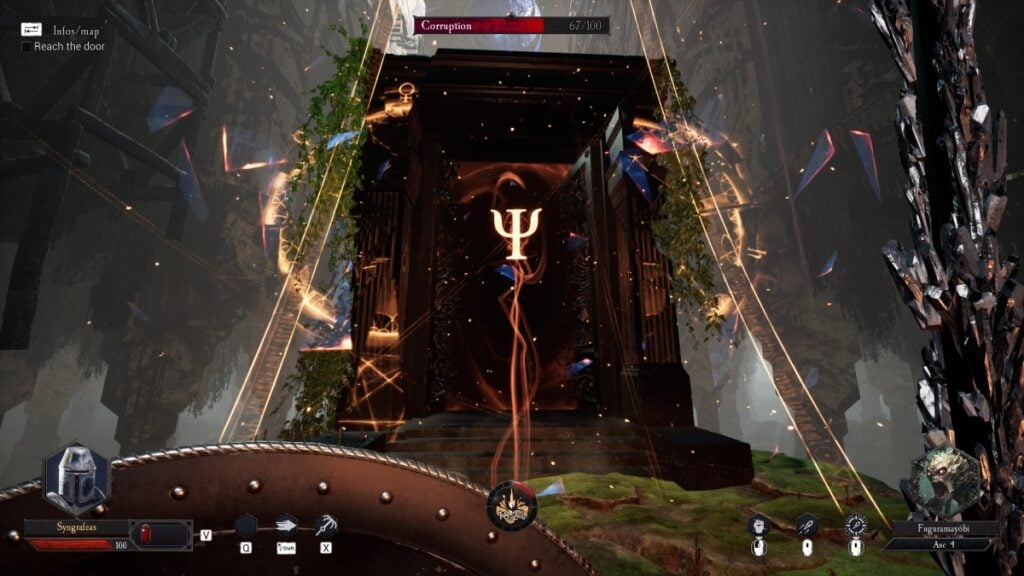
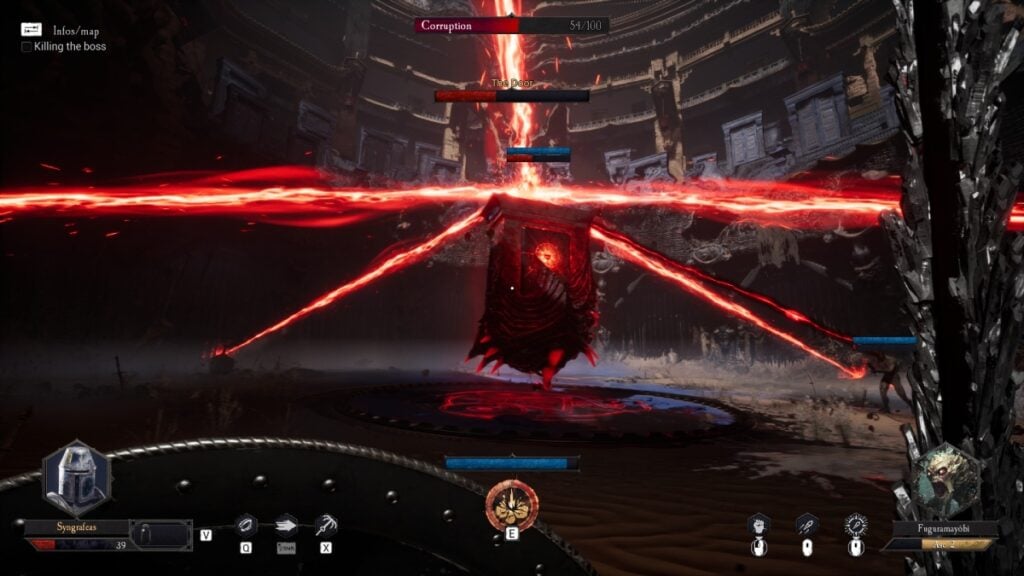
On top of that, every zone has a distinct objective, such as standing in a circle until a bar fills up or destroying objects before progressing to the next area. At the end, you’ll encounter a boss, and I was also glad to see how different and dynamic they felt. The first one, for example, required you to defeat different chained enemies to prevent the boss from becoming stronger, while the second was a floating door that shot lasers.

Once you manage to beat a boss, you have the option to return to the hub to upgrade your weapons or stats or continue delving deeper, but with the risk of losing your loot should you perish. Speaking of which, while Daimon Blades has several roguelite aspects, dying in battle isn’t the end. There’s a corruption bar that fills up each time you fall, typically in 20% increments, and if it reaches 100% it will show you the game over screen.
Overall, Daimon Blades is a promising first-person slasher with great roguelite mechanics that is excellent for some chaotic slasher action alone or with other players. It could use some work on several key elements and improve its explanation, but even with those issues, it is still quite enjoyable. In truth, I’m excited to see how far this game goes because it’s been a while since we’ve had an experience with such fast and brutal swordplay accompanied by in-depth progression systems.