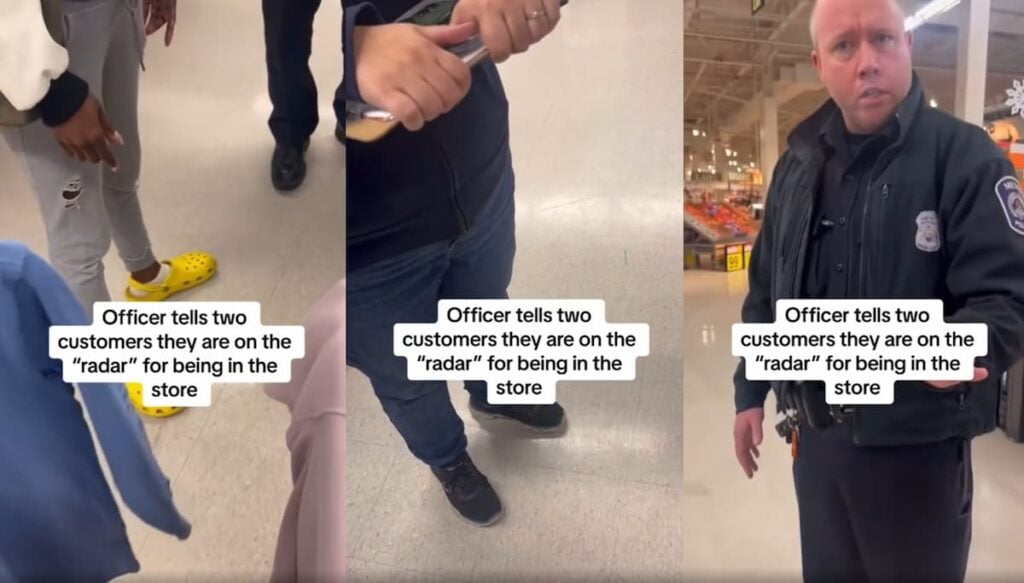
A woman from Texas recorded herself being removed from a shopping store she’d never stepped foot in before, not because she stole anything, but because security insisted she was already “on the radar.”
The confrontation shows the woman and her friend browsing clothes at an out-of-state retail store, items in hand, fully intending to make a purchase. That’s when a security guard approaches and tells them they need to leave immediately. His reasoning is vague but firm: they’re “known shoplifters.” Except there’s a problem with that thesis: the woman explains she isn’t even from that state.
“I’ve never shopped here before,” she tells the guard, repeatedly asking how she could possibly be flagged at a store she just walked into. The guard sticks to the same explanation, denying racial profiling while offering no clear details beyond the ominous phrase “you’re on the radar.”
As the exchange grows more tense, the women push back, accusing the guard of profiling them for being Black. He denies it again, even as his justification remains unchanged. At no point do the guards accuse them of stealing anything in that moment, only that they supposedly fit some pre-existing suspicion.
Things escalate further when a second security guard arrives and tells the women she’s “just had a call about you.” The woman recording immediately challenges that claim.
“Who called? I only just walked in.”
No caller is identified. No description of alleged prior theft is given. No evidence is presented. Both guards continue insisting the situation has nothing to do with race, while simultaneously failing to explain how two shoppers from another state could already be flagged as known offenders.
The video ends rather abruptly. It seems to be a stitch with another content creator reacting to what they’re seeing toward the end. I couldn’t find the original, unfortunately. Still, the footage has ignited a familiar debate: was this racial profiling, or an example of legitimate loss-prevention practices that simply looked bad on camera?
Some commenters floated alternative explanations, including facial recognition systems, shared retail databases, or even suspicion over a large beige bag one woman was carrying. A former retail worker suggested employees may have noticed “looking and scanning surroundings” — a behavior some loss-prevention teams are trained to watch for.
But for many viewers, those explanations make no sense.
Apparently melanin is just so suspicious.
Others pointed out that “looking and checking” is literally how shopping works, and questioned why security didn’t simply monitor the women instead of asking them to leave outright. Several also noted the guards’ contradictory logic: if there was truly another incident requiring attention, why were both guards focused on two customers who hadn’t stolen anything?
The phrase “on the radar” became a particular lightning rod. “Radar can detect melanin now?” one commenter joked, while others argued the language sounded more like an excuse than a policy.
TikTok comments on the same video echoed that sentiment, with users sharing similar stories of being followed, questioned, or outright accused while shopping. One commenter wrote, “Why can’t we just be black in peace… It’s draining.” Another congratulated the woman sarcastically: “You just got paid.”
The incident taps into a long-standing pattern often described as “shopping while Black,” where normal consumer behavior is treated as suspicious. Even commenters who tried to give security the benefit of the doubt acknowledged that these situations rarely seem to happen to white shoppers under the same circumstances.

Because the video cuts off abruptly, there’s no confirmation of what happened next: whether management got involved, whether the store apologized, or whether any legal action followed. That lack of closure has only fueled speculation and frustration.
What remains clear is the disconnect between the guards’ certainty and their inability to explain it. If this wasn’t racial profiling, critics ask, why did the explanation never evolve beyond an unprovable claim that made less sense the more it was repeated?