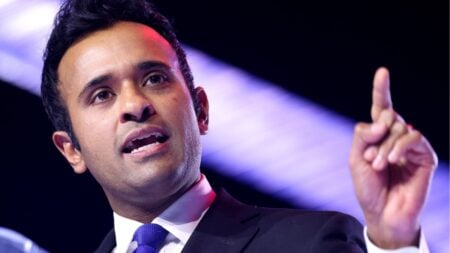
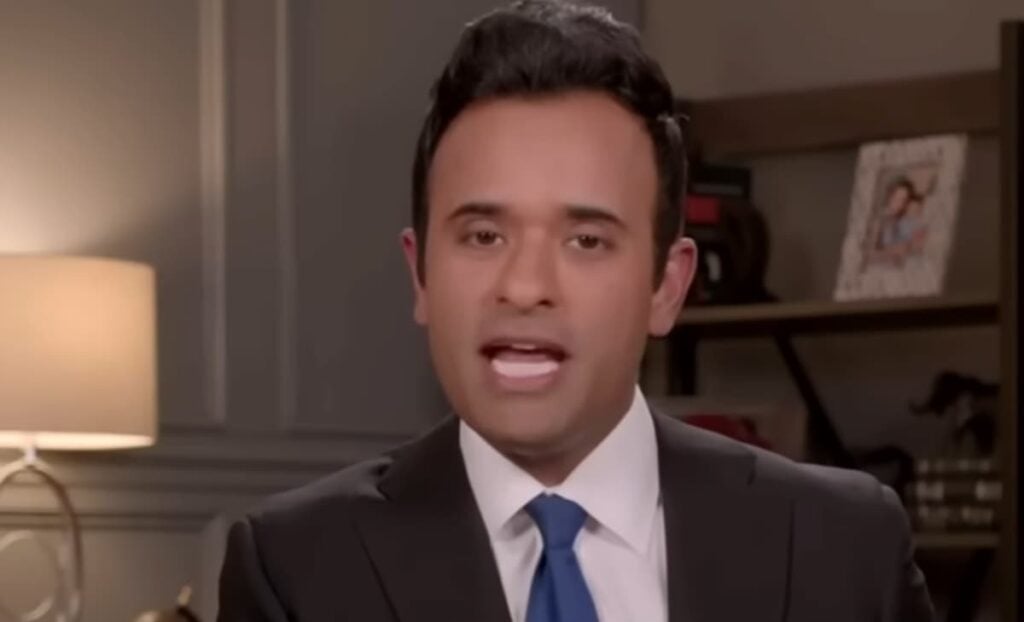
Republican gubernatorial frontrunner Vivek Ramaswamy has injected $25 million of his own money into his Ohio campaign, reinforcing a commanding financial advantage as the race begins to sharpen ahead of November.
The Columbus-area entrepreneur and billionaire had long been expected to make a significant personal investment. The move builds on an already record-setting fundraising pace, with Ramaswamy bringing in nearly $19.5 million in 2025 alone. By comparison, likely Democratic opponent Amy Acton raised roughly $4.4 million over the same period, a strong showing historically for an Ohio Democrat but still far behind.
As reported by cleveland.com, Ramaswamy’s campaign has also reserved $10 million in television and digital advertising through the general election, signaling a strategy built on early and sustained visibility. While he still faces a Republican primary on May 5, his opponents are not widely viewed as serious threats.
Still, the scale of the self-funding has sparked immediate and often pointed reactions from Ohio voters online, where skepticism about both his wealth and motivations has taken center stage.
“Drop in the bucket for this guy. He lives in a completely different world than the rest of us and should have no say in governing us,” one Ohio subreddit user wrote in a widely upvoted comment.
Questions of Wealth and Motive Surface
Much of the online discourse has focused less on the mechanics of campaign finance and more on how Ramaswamy built his fortune. Several commenters raised allegations tied to his biotech career, particularly around past drug development efforts. These claims remain unproven, but they continue to circulate in public forums.
“Just a reminder that he is a complete fraud,” one user alleged, referencing a controversial Alzheimer’s drug development process and suggesting it helped inflate investor interest before failing in later trials.
Others questioned the broader rationale behind such a large personal investment in a public office that pays a fraction of that amount annually.
“What’s the point of dumping this amount of money into a job that pays so little if you don’t think you’ll make the money back?” another commenter asked, echoing a recurring theme about power and influence.
That sentiment was repeated across the thread in different forms, with some users framing the campaign as a pursuit of political leverage rather than public service.
“Honestly once you have billions what’s left to want other than power?” one post read.
Ramaswamy’s campaign has not publicly addressed the online criticism, though Acton’s team seized on the moment. Her campaign manager, Phil Stein, argued the $25 million infusion reflects internal concern.
“He can continue throwing money at his campaign from the seat of his private jet, but Ohioans see right through his false promises,” Stein said in a statement.
As the race develops, the financial gap between the candidates remains significant. But the online backlash suggests that, for some Ohio voters, the source and scale of that money may become as much a campaign issue as how it is spent.