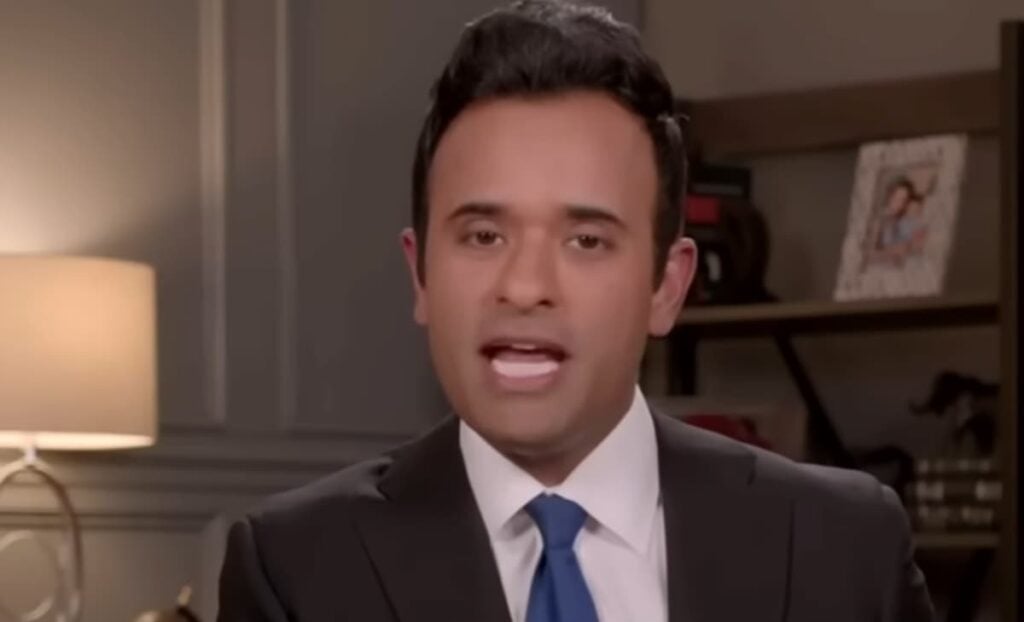
Ohio’s growing battle over data centers took another dramatic turn this week after a report spotlighted Republican gubernatorial nominee Vivek Ramaswamy’s investments across industries connected to the very facilities he has championed as a cornerstone of the state’s economic future.
The report, published by Innovation Ohio, argues that Ramaswamy’s financial holdings span multiple layers of the data center ecosystem, including chip manufacturers, artificial intelligence companies, hardware suppliers, and cryptocurrency-related businesses. Critics say that raises serious questions about potential conflicts of interest if he were elected governor and given authority over agencies that approve, subsidize, and regulate the industry.
The story quickly sparked heated reactions online, particularly among Ohio residents discussing the issue on Reddit.
One commenter summed up the frustration bluntly: “Imagine voting for this guy,” while others made scathing comments, such as calling him “Ramscammy” and a “real-life Mr. Burns.”
Others focused on what they viewed as a disconnect between Ramaswamy’s vision for Ohio and concerns being raised by communities already grappling with data center development.
“Ramaswamy has spent most of his adult life outside Ohio,” one user wrote. “On two major issues, he is out of step with Ohioans.”
The controversy arrives at a time when data centers have become one of the state’s most polarizing development issues. Supporters argue the facilities bring billions in investment and help position Ohio as a technology hub. Opponents point to rising electricity demand, tax incentives, and concerns that the facilities create relatively few permanent jobs compared with their enormous footprint.
Locals Don’t Want “Pay-to-Play”
Many online reactions centered not on data centers themselves, but on the perception that public policy could benefit private investments.
“We don’t want him, his dirty money, or pay to play with our state,” one commenter wrote.
Another questioned the broader trend of wealthy business figures seeking political office.
“Why do we keep elevating these type of people in our politics?” the commenter asked. “The people with the most conflicts of interest between their wealth and serving the public interest.”
Several users shared petitions and activist groups opposing further data center expansion, while others pointed to local efforts around Ohio to slow or block construction projects.
The criticism was not limited to traditional partisan arguments. Some commenters specifically framed the issue as one of transparency and accountability, regardless of political affiliation.

At the center of the debate is a simple question that continues to gain attention as the governor’s race unfolds: can a candidate heavily invested in industries tied to data center growth make impartial decisions about their future?
For many Ohio residents following the story, that question remains unanswered. With projections showing dozens of new data centers potentially arriving in Ohio over the next several years, the controversy surrounding Ramaswamy’s investments appears unlikely to fade anytime soon. As one commenter put it, “How is this not a conflict?”