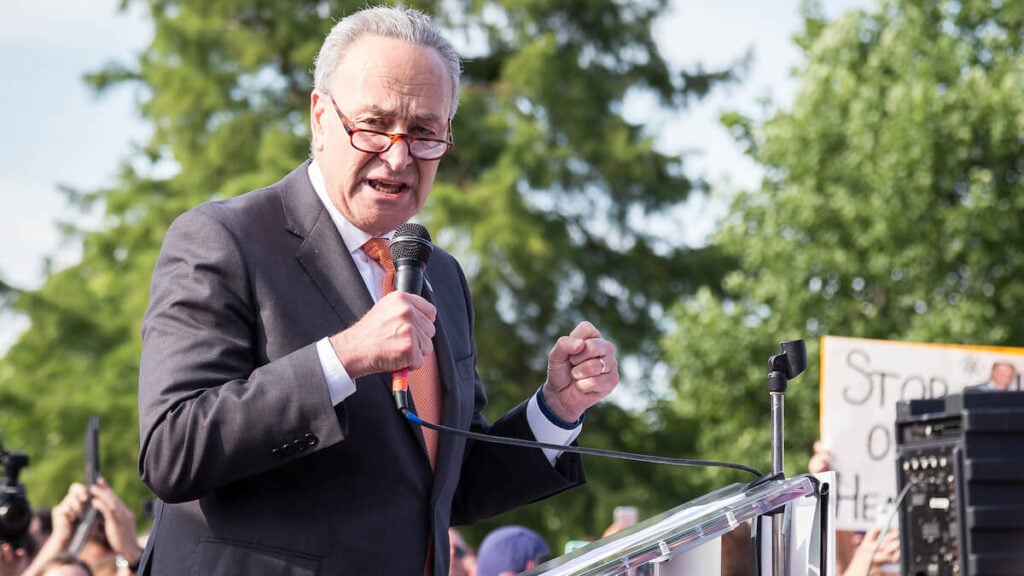
New York Sen. Chuck Schumer faces hypocrisy accusations after criticizing President Donald Trump for calling Vladimir Putin a friend. The president made the remark while greeting the Russian leader in Shenzhen, China, on Thursday. Critics also questioned Schumer’s support for Israeli Prime Minister Benjamin Netanyahu.
The Associated Press shared footage of the encounter during the Asia-Pacific Economic Cooperation summit on X. As Trump approached Putin, he asked, “Who is he? He’s my friend.” The two leaders then shook hands.
Schumer shared the footage on X and challenged Trump’s description of the Russian president. “Who is he?” he asked, accusing Putin of abducting tens of thousands of children and killing civilians. He also cited attacks on Ukrainian infrastructure and the wrongful detention of Americans.
“Donald Trump considers him a friend,” he wrote. “Embarrassing, despicable, and quite frankly pathetic.” He added that Senate Democrats would continue standing with Ukraine and opposing Putin and other authoritarian leaders.
Chuck Schumer Faces Hypocrisy Accusations Over Israel and Netanyahu
The criticism quickly shifted toward Schumer’s position on Israel, while others defended maintaining diplomatic relations with Russia.
“Where’s this same opposition to Israel and Netanyahu?” one person questioned. Another drew a comparison with Schumer’s own relationships, writing, “You consider Netanyahu a friend.”
Others challenged his concern for civilians caught in conflict. “LOL at you pretending you care about civilian deaths,” one response stated. Another questioned his willingness to act, writing, “Here’s a bet…you won’t cut war funding.”
However, some defended Trump’s engagement with Putin. “Maintaining diplomatic relations, even with adversaries, is part of a president’s job,” one person argued.

A separate response questioned the alternative, asking, “So, do you want us to go to war with Russia? Or do you want us to negotiate peace?”
Schumer’s post did not address U.S. military assistance to Israel. The question of whether he supports changing that assistance remains unanswered in the exchange.