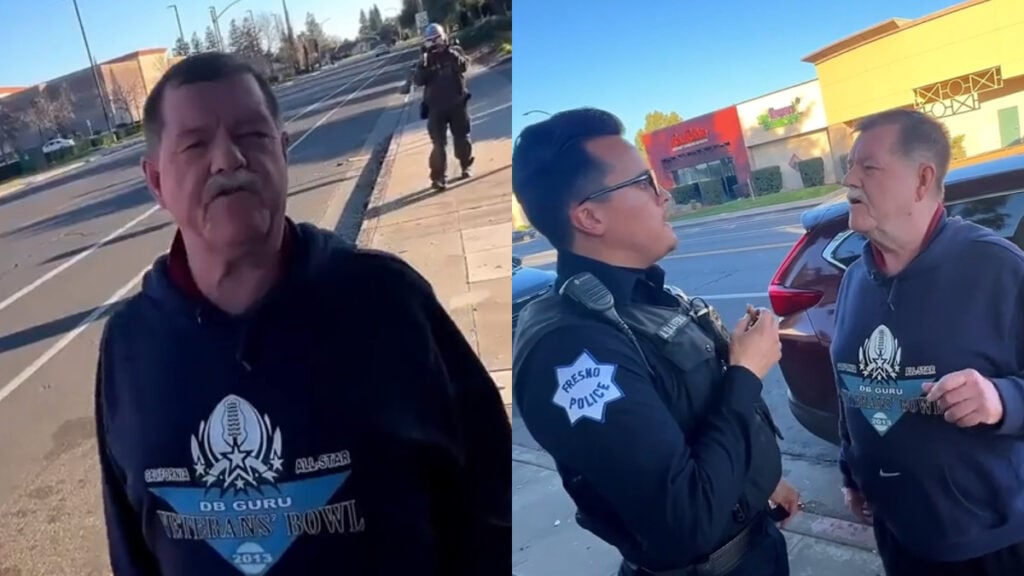
There are all kinds of internet niches, ranging from genuinely wholesome content to things that exist almost entirely to stir discomfort. Somewhere in the middle sits a category that many people find especially irritating: videos built around provoking reactions from strangers. A common version of this involves a cameraman who records people in public spaces, often lingering just long enough to make those being filmed feel uneasy or annoyed. While the practice is usually legal, especially when done on public property, it predictably leads to tense confrontations. Not many people enjoy having a camera pointed at them or their belongings without consent, even if the law allows it. One such incident recently unfolded in Fresno, California, where a cameraman filming in a public area recorded a man’s car.
The Fresno man clearly took issue with this and quickly confronted the cameraman. The video shows the man walking up angrily, demanding that the cameraman get away from his vehicle. The cameraman responded by telling him to calm down and repeatedly asked him not to touch him. The Fresno man insisted that he was not touching the cameraman, but accused him of deliberately trying to provoke a reaction and told him to stop filming his car.
The exchange escalated into a heated argument. Both the Fresno man and the cameraman traded insults, criticizing each other’s appearance and making jabs about personal hygiene. The situation remained verbal, but it was clearly tense, drawing attention from people nearby. Not long after, a Fresno police officer who happened to be in the area approached the two men to see what was going on.
The Fresno man immediately tried to explain his side to the officer, arguing that the cameraman was harassing him by recording his car and refusing to stop. Many viewers might expect the police to sympathize with someone who feels targeted or provoked. Instead, the officer took a calm and matter-of-fact approach and explained that the cameraman was not breaking the law. According to the officer, recording in public spaces is legal, including filming cars that are visible from public property.
The officer went on to tell the Fresno man that while the situation was understandably frustrating, the cameraman had the right to film. If the Fresno man was uncomfortable, the officer suggested that he could move his car or leave the area. The Fresno man continued to insist that the cameraman was intentionally harassing him, but the officer did not change his position. With no legal grounds to force the cameraman to stop, the encounter ended with the Fresno man walking away, clearly dissatisfied.
Online reactions to the Fresno incident were mixed. Many commenters said they understood why the Fresno man was upset, noting that the cameraman’s behavior felt deliberately provocative even if it was legal. One user commented, “Don’t feed the trolls. Just ignore them and they’ll move on.” Another person claimed to recognize the Fresno man from the video, adding, “That guy with the mustache was a coach at my high school. He was always a nice guy.”
Others focused more on the police response, praising the Fresno officer for clearly explaining the law and remaining calm throughout the situation. One comment read, “Impressive to see Fresno police actually explain the law correctly. I’ve seen plenty of videos where officers completely misunderstand this stuff.”