

North Carolina Republican congressional hopeful Austin Ayers is once again facing backlash after posting what many are calling a cruel, juvenile, and deeply insensitive poem on X. This move, critics say, confirms his role less as a serious political actor and more as a professional rage-baiter chasing attention.
Austin Ayers, who has repeatedly courted controversy through inflammatory posts, shared a short poem mocking Renee Good, the woman fatally shot during an ICE operation in Minneapolis. The poem framed Good as mentally unstable, blamed her for her own death, and treated the incident as a punchline.
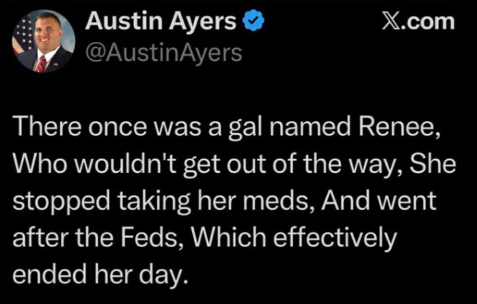
On r/NorthCarolina, commenters condemned both the content of the poem and Ayers’ apparent intent. While many users rejected the framing of Ayers as a legitimate candidate at all, others focused on the sheer callousness of turning a real person’s death into political mockery.
One of the most upvoted responses flipped Ayers’ own format back on him:
“There once was a *expletive* named Austin
Whose poor attempt at humor would cost him
When the trump regime fell
Folks remembered him well
And in every election they tossed him.”
Others were more direct about what they saw as Ayers’ motivations. “His entire goal with this is to rile liberals,” one commenter wrote, while another argued that reposting his content only feeds the cycle: “He’s not a candidate and reposting his shit is exactly what he wants.”
That view was echoed repeatedly throughout the thread. Multiple users pointed out that Ayers’ posts typically receive only a handful of likes on X and are routinely obliterated in the replies. To them, the poem was a failed attempt at virality.
The backlash also reignited criticism of Ayers’ self-applied political labels. Though he has styled himself as a libertarian, commenters were quick to note the contradiction between that identity and celebrating what they described as an extrajudicial killing by federal agents. “Imagine slapping ‘Libertarian’ next to your name and then celebrating the feds,” one user wrote.
Beyond ideology, much of the reaction fixated on tone. Even among users accustomed to rough-and-tumble political discourse, the poem demonstrates a disturbing flippancy toward death. Several commenters noted the hypocrisy of mocking Renee Good while reacting furiously to criticism of right-wing figures, arguing that outrage is selectively applied depending on who the victim is.

As with Ayers’ previous controversies, questions also surfaced about whether he is meaningfully running for office at all. Multiple commenters claimed he failed to qualify for the ballot, is not actively campaigning, or lacks any real organizational backing, which further reinforces the perception that his online presence is about provocation, not public service.
In the end, the poem only appears to have united a broad swath of North Carolina citizens in their assessment of Ayers himself. Whether viewed as a troll, a grifter, or simply a failed candidate shouting into the void, the consensus was pretty clear.