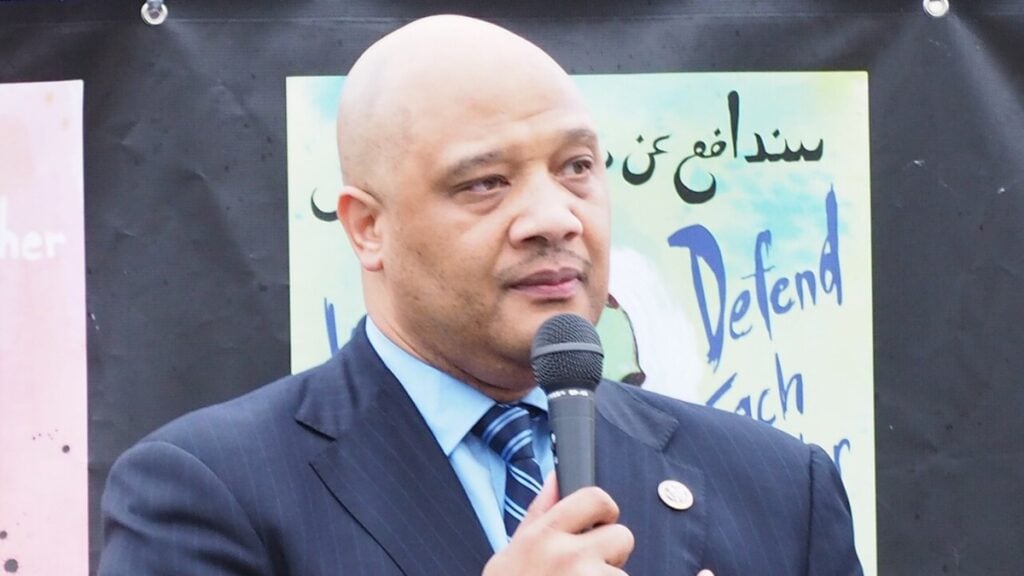
Indiana Rep. André Carson is accusing ICE of racial profiling amid reports of increased immigration enforcement in Indianapolis, pointing to national arrest data as evidence that the agency isn’t primarily targeting violent criminals. Carson also announced a congressional inquiry seeking answers about ICE activity in the city and said he continues to oppose funding the agency.
Carson’s criticism comes amid continued reports of stepped-up ICE activity around Indianapolis. ICE has not publicly provided a full accounting of the operation or the number of people arrested in Marion County, while more than 100 protesters gathered outside the agency’s Indianapolis office Saturday as concerns over the enforcement activity continued.
The video shows Carson speaking to the camera in a suit. He says, “These arrests don’t make our city safer,” and refers to “chasing a car across multiple lanes of traffic, as ICE has reportedly done in Indy.” he adds, “So, ICE is making our city less safe.”
Carson’s office pointed specifically to a Sept. 1 incident near Post Road and Interstate 70, where video reportedly showed ICE agents pursuing a man across several lanes of traffic. Carson cited the incident in his congressional inquiry as an example of enforcement tactics he believes endangered Indianapolis residents.
Later, Carson argues that the arrests don’t appear to be focused primarily on people with criminal records, saying they instead “appear to be based on racial profiling.” The footage is an interview excerpt only. It does not show an arrest, and it does not include the full interview or independent confirmation of the statistics he cites.
In the accompanying caption, Carson wrote that 96% of people ICE arrested in July “did not have a prior violent criminal conviction,” that the arrests “aren’t about safety,” and that they are “about racial profiling.” He said he submitted a congressional inquiry into ICE’s presence in Indianapolis and “refuse[s] to fund ICE as they terrorize our communities.”
Carson’s congressional inquiry asks DHS for significantly more information about the Indianapolis activity, including how many people have been arrested or detained, the legal authority supporting the arrests, whether those individuals had criminal convictions or pending charges, whether warrants or removal orders were involved, and where those detained were ultimately taken.
Carson’s ICE Claim Sparks Backlash
Many commenters rejected the idea that a prior violent conviction is required for immigration enforcement. One widely liked reply said, “THEY BROKE THE LAW AND MUST GO.” Another wrote, “They all gotta go.”
A third said, “I don’t care if they have a violent criminal conviction or not, they’re here illegally, and they have to go.”
Others made the same point in legal terms. “A criminal conviction is NOT a requirement to be deported. Entering our country illegally is,” one user wrote.
Another asked, “Since when do you need to have a prior violent crime arrest to be arrested for a crime you are committing?” and added, “Illegal immigration IS the crime.”
Those comments blur an important legal distinction. Immigration violations can provide grounds for civil immigration enforcement and removal even without a violent criminal conviction, but unlawful presence itself is generally a civil immigration violation rather than a criminal offense. Illegal entry can constitute a federal crime under separate circumstances.

A smaller share treated the 96% figure as a reason for scrutiny, with one commenter saying that if most people arrested “didn’t have a prior violent conviction that deserves serious scrutiny” and that enforcement “should be focused on genuine threats to public safety.”
The argument isn’t ending with Carson’s X post. Reports of increased ICE activity continued around Indianapolis into the weekend, drawing more than 100 protesters to the agency’s local office Saturday. Carson is now waiting for DHS to answer his congressional inquiry, which could provide something still missing from the debate: a clearer picture of exactly who ICE has arrested in Indianapolis, why they were targeted, and what happened to them afterward.