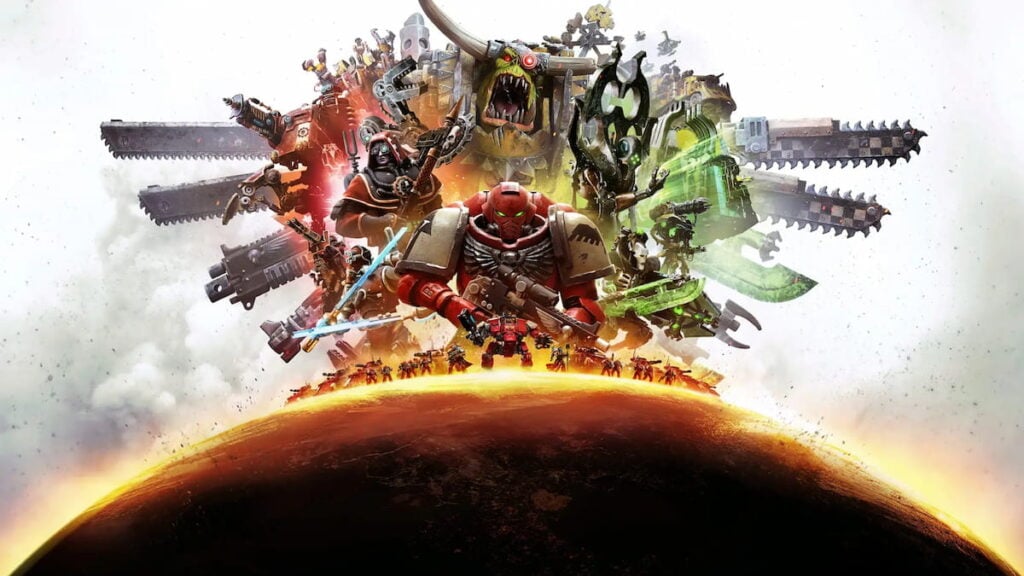
For over a decade, Toby Longworth’s voice has resonated across the grim darkness of the far future. Having lent his vocal talents to Warhammer 40,000 audiobooks and iconic video games like Space Hulk: Tactics and Darktide, Longworth is now stepping back into the fray for Warhammer 40,000: Dawn of War 4, voicing the legendary Primaris Marines, ancient Dreadnoughts, and the secretive Dark Angels.
We recently spoke with Toby about the vocal challenges of playing an entombed war machine, the secret to creating distinct Space Marine voices, and how much cinema inspires his performances across gaming.
*This interview was edited for clarity.
The Nerd Stash: You’ve voiced Space Marines across multiple Warhammer 40K projects now—Space Hulk: Tactics, Darktide, and others. How does stepping into Primaris Marines and Dreadnoughts for Dawn of War 4 compare to that earlier work? Is there a different register you reach for when the character is entombed in a Dreadnought chassis versus a standard power-armored Marine?
Toby Longworth: I think the Dreadnoughts are one of the most fascinating characters in the whole of Warhammer. I mean, loyalty until death is one thing, but after that, it really takes it up a notch. As you say, I have voiced many characters in both audiobooks and games, but some projects (particularly games) come to me under codenames—for security, I guess —and sometimes even after they are released, I’m never quite sure which characters belong to which project. So for me, it feels a little like I have simply been exploring the Warhammer world as a whole from all aspects.
TNS: Dawn of War‘s original games are famous for genuinely quotable unit barks that fans still quote 20 years later. You’ve played many characters in a single recording before. What’s your trick for making a bunch of similar space-soldier voices actually feel like different people?
Longworth: Now that’s a great question. It is always a good idea to have a particular personality or attitude in mind first. This might come from a fictional character, a person you know, or someone in the news. You are not looking to do an impersonation, just for a starting point for a character. Age, attitude, temper, or even sense of humor all play a part. And of course, particularly in audiobooks, keep an eye on who meets who, so there is plenty of contrast or the listener may get confused. In the Warhammer world, there is always a lot going on, and it’s your job to tell the story clearly, accurately, and, hopefully, excitingly.
TNS: This might be a stretch, but you played the lead in Amnesia: A Machine for Pigs, who was a pretty dark character surrounded by mental anguish. A Dreadnought is basically an ancient warrior’s mind stuck inside a giant war machine. Did anything from that role end up bleeding into how you played this? Or does all your previous experience essentially come together for each project and role?
Longworth: It’s really interesting you make that link; I hadn’t thought about it. Amnesia was a long time ago. I seem to recall being inspired (if that’s the right word) by the films Re-Animator and Cronenberg’s Dead Ringers… When it comes to the Dreadnought, I realize one of the images I have uppermost in mind is from RoboCop, particularly the failed first attempts, which remind me: not everyone can successfully transition to a Dreadnought…
TNS: I know the Dark Angels are a new addition to this game, and they’re a bit more secretive/mysterious than the other Space Marine groups. Did anyone give you notes on making them sound different, or is that something you dig deep on before you step into the booth?
Longworth: I always start from the point of view that the characters who are part of this faction, or any faction, feel the faction chose them rather than the other way around. That this is their destiny. It’s a bit hard to explain, but as I’ve been citing a lot of film references, I’ll do it again. For me, the style of acting in John Boorman’s Excalibur exactly defines the feeling of destiny, honor, solemnity, and savagery that the Warhammer universe is powered by, and if you can get some of that into every character, you are doing something right.
TNS: You’ve been doing Warhammer audiobooks and games for over a decade now. What are the main differences between audiobook performance and video game performance for you? Does it feel just as fresh going into a new project like this?
Longworth: There are many differences between audiobook performance and video game performance. For one thing, a game is almost exclusively focused on action, so it requires you to be up on your feet, moving and jostling, and as a result can be pretty exhausting. An audiobook requires fierce concentration to build the world for the listener, and as a result, the recording can become very immersive—you can spend hours hardly moving, which can also be quite physically taxing.
There are technical differences too. For instance, the mic in a video game will usually be tethered to you in some way, so the game engine can place you within the soundscape of the greater game world. Whereas in the audiobook world, the mic is fixed, so you are able to come in close to whisper deadly threats or sit back and loudly rally the troops.
TNS: When preparing to voice a role in the gaming space, do you get a chance yourself to play and see the games before or during your sessions? And if so, has playing or seeing a game for yourself impacted how you approach that role?
Longworth: Although I do play games (at least, I do when I get time), I try not to think much about the final game when I’m recording. It’s kind of the same for audiobooks. I prefer to think of the story I’m telling or the character I’m playing as something that is actually happening or has happened. I’m not much of a one for giving out advice, but I think if I was advising someone who wanted to get into this field, that would be my top tip: imagine it is all true and everybody you play is a real person. Of course, in the Warhammer universe, that’s a pretty terrifying prospect, but it still holds true. Besides, I don’t think any of us would want it to be any other way.
For those who want to hear his in-game Dawn of War 4 performance, you will have to wait until December 3rd, when it releases on PC.