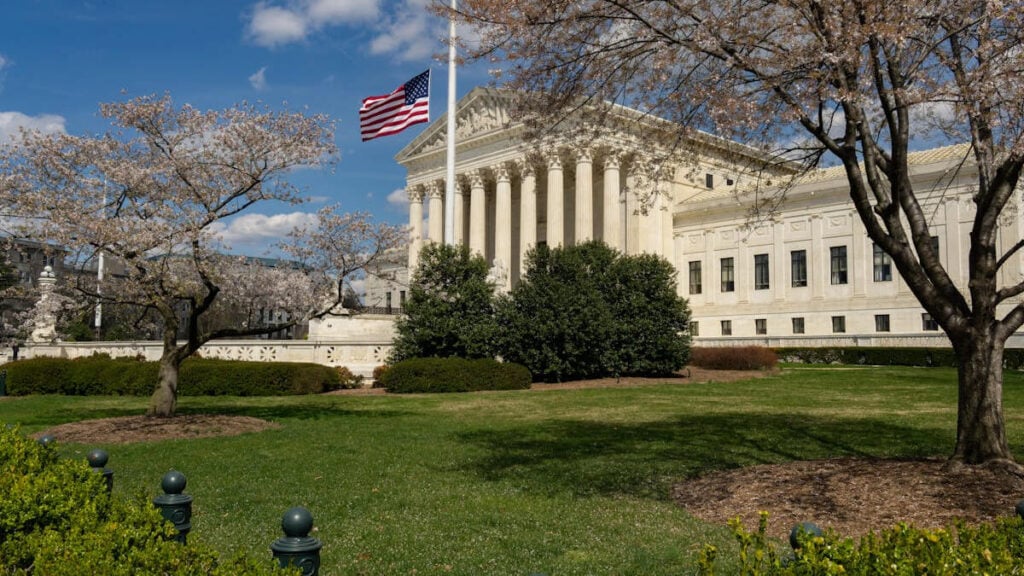
The U.S. Supreme Court reversed a lower court ruling Monday that found Mississippi lawmakers “unlawfully diluted Black voting strength” through legislative redistricting. The brief order vacates a decision that led to Democratic gains and ended a Republican supermajority. The case now returns to federal court for further legal arguments.
The legal dispute centers on district maps enacted in 2022 that the lower court found violated the Voting Rights Act. Three federal judges appointed by George W. Bush originally ordered the state to create additional majority-Black districts. The high court cited its recent Louisiana decision as the basis for the reversal.
Governor Tate Reeves described the reversal as a “win for the principle that all Americans are created equal.” Justice Ketanji Brown Jackson dissented, stating she saw “no basis for vacating the lower court’s judgment” because the appeal addressed a different legal issue. Secretary Michael Watson praised the “more constitutional approach.”
Residents Blast Supreme Court Redistricting Reversal
“Open season racism and bigotry in the deep south,” one participant noted following the court’s intervention in Mississippi. A separate commenter argued the ruling demonstrated that “The supremacist court ruled that the lower court was wrong for calling racism bad”.
“Remove minority power,” one legal contributor asserted while comparing the order to recent redistricting shifts in Louisiana. A separate observer asked how the judiciary can remain “respected as at least plausibly non-partisan after this”.
“Roberts trying to outdo the Dred Scott and Korematsu courts in terms of infamy,” a member of the community noted. Another observer warned, “Jim Crow Roberts won’t stop until our economy is based on slavery and cotton”.

A contributor stated that “The way it exists now has lost all credibility” and argued for complete reform of the federal judiciary. A separate participant suggested, “If karma is real, they have sealed their own fate 100%”.
The public challenge to the court’s institutional integrity persists, with critics continuing to question the decision as the restoration of the previous maps is expected to reshape political control and influence future elections in the state.