
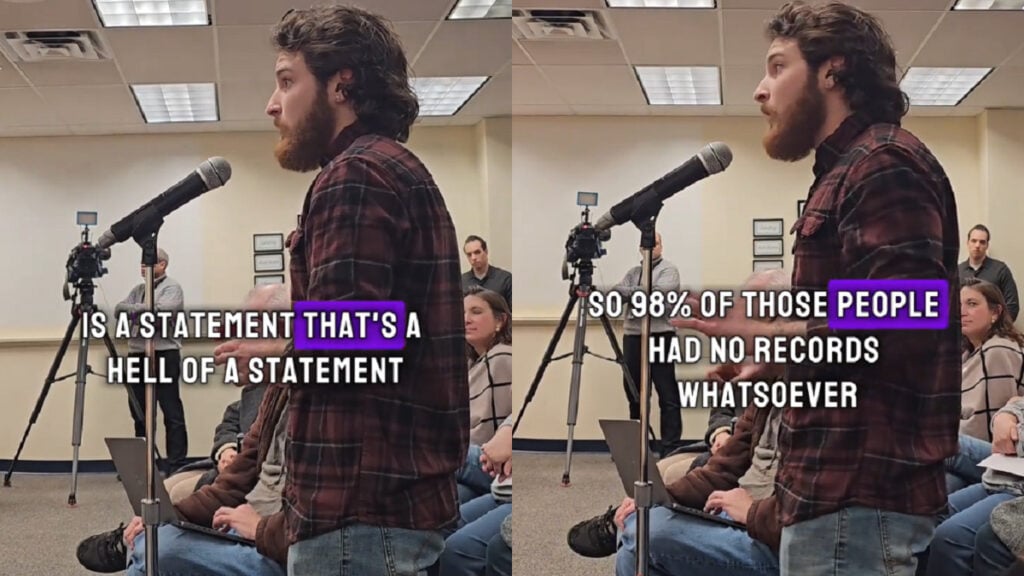
We live in a time when divisions between groups within the country have become more pronounced. Right now, immigrants are public enemy No. 1 as far as the Trump Administration is concerned. Using ICE raids as a way to sweep through streets and possible orders of U.S. troops being deployed in Minnesota, it’s unclear when it’ll end. Protests are ongoing, and people are doing what they can. One Roxbury local, for example, stood up at a New Jersey town council meeting to push against hateful rhetoric towards immigrants.
A clip of the town meeting shared by TikToker NJ50501 showed a local, identified as TikTok user Catdadcas, speaking. He told an entire room full of Roxbury citizens, “Nobody in this room is struggling because of an undocumented migrant.” He continued by arguing that undocumented immigrants are not the reason people are struggling to afford healthcare, food, or housing, stating, “Nobody is struggling to pay for their healthcare or their food or their housing because of an undocumented person.”
He also addressed the murder of Renee Good and stated that, in his view, no one should support DHS or ICE. He also claimed that ICE is housing detainees in what he described as “concentration camps,” and said the agency is detaining people broadly, not just those with criminal records. He read a study from Newark, NJ that stated only “2% of the people they kidnapped had criminal records,” resulting in 98% having “no records whatsoever.”
Cas addresses the council members, stating “You have power at the end of the day. And I hope you do what’s right.”
One commenter stated, “48% of owner occupied home sales last year were private equity – the thing that’s making life hard for Americans is corporate greed, corporate welfare, and a class war that is coming to a head internationally.”
The speaker also left a comment, stating “Use your voices,” because immigrants “need your support.”

One commenter pointed out, “We struggle because our government chooses to help the richest in this country again and again. Immigrants are the scapegoat and the distraction.”
The comment reflects a broader criticism of immigration policy, arguing that public perceptions are often shaped more by rhetoric than by crime statistics, which show immigrants are less likely to commit violent offenses than native-born citizens.