Doctors, nurses, and patients alike often face many problems stemming from the state of general healthcare in America. While some solutions are being suggested, certain ones have sparked concern and outrage, such as telepresence robots, which apparently allow doctors to work remotely while still monitoring their patients. This tech was deployed in North Carolina hospitals and has since gone viral.
Now, hospitals across North Carolina are facing backlash after deploying telepresence robots, mobile, screen-equipped devices that allow doctors to remotely interact with patients, supposedly as a solution to growing staffing shortages and physician burnout.
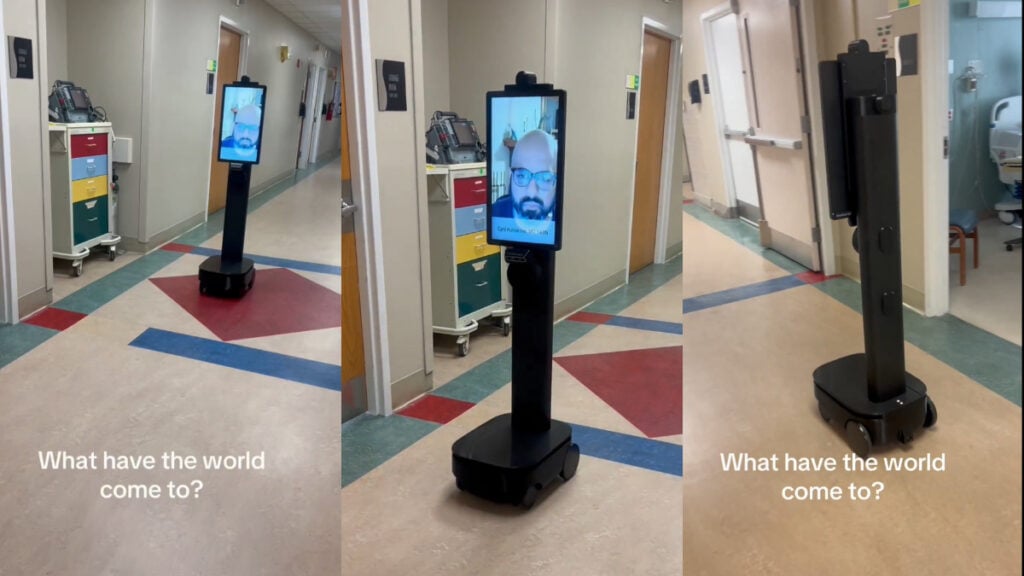
The controversy erupted after a short viral video circulated on social media showing a wheeled robot gliding through a hospital corridor, its large screen displaying a physician speaking in real time. The device maneuvered past patient rooms and equipment, offering a glimpse into what some are calling the next phase of modern healthcare.
It’s worth noting that these robots are not autonomous doctors. Instead, they function as remote-controlled communication tools, enabling real physicians to examine, diagnose, and consult with patients from miles away. Hospital systems reportedly introduced the technology to extend care to underserved areas and reduce the physical strain on overworked staff.
Supporters, such as certain licensed doctors, argue that the approach is a practical response to a real crisis. Rural and understaffed hospitals often struggle to maintain access to specialists, and telepresence devices can bridge that gap. By eliminating travel time, doctors can consult with more patients across multiple locations in a single day.
People Online are on the Fence
However, many people online were not keen on the idea’s implementation. “Not that I agree with this concept, but here is a more affordable way to implement this concept,” suggests one X user, “Change out the TV’s in every room. put up monitors and do remote visits. Most of us know how to do ZOOM meetings now a days.” That could offer something more affordable in the long run.
Meanwhile, another commenter echoed the general public’s sentiment towards the healthcare sector, saying this new robotic gap-bridge is open to abuse, “But more and more Big business will abuse this as they continue to find new opportunities to make $$$ at the expense of our privacy and freedoms.”

“A real human doctor is operating this remotely and speaking with patients, to help combat burn out. How exactly is this helping?😆 if the real life human doctor still has to drive the robot why doesn’t the real life human doctor just go talk to the real life human patient,” rants a skeptic.
Still, others push back on the dystopian narrative, noting that millions of Americans already live in areas with limited or no access to specialized care. For those patients, a remote consultation may be far better than no consultation at all.