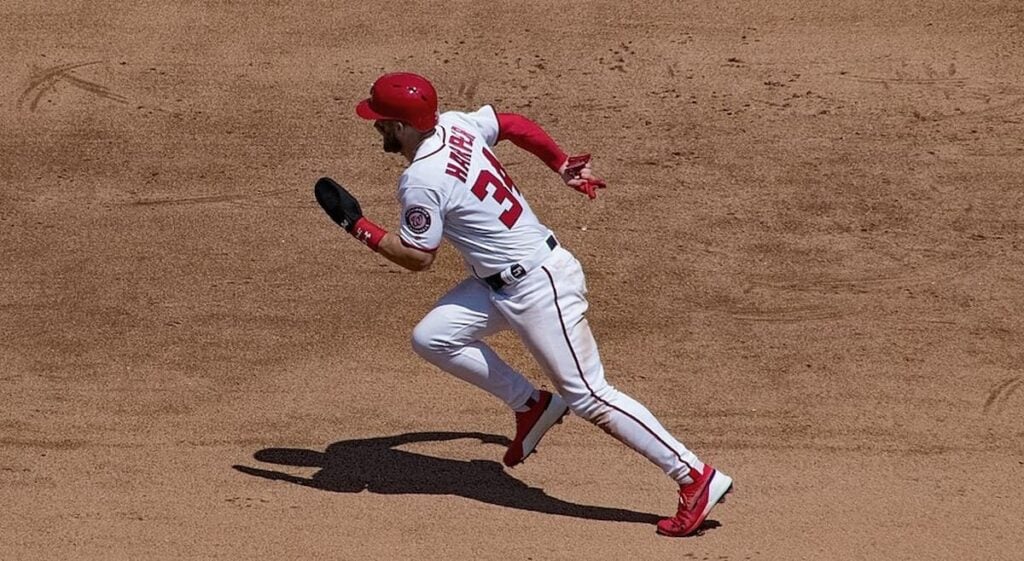
Bryce Harper did not place the bets, file the lawsuit, or allegedly design the VIP system. But the Philadelphia Phillies star is now at the center of one of the ugliest sports-gambling debates of the week.
A new report from The Philadelphia Inquirer revealed that FanDuel sent a personalized video message from Harper to Terry Thompson, a bettor who says he lost massive sums while battling gambling addiction. According to the Inquirer, Thompson wagered $18.5 million with FanDuel after first using the app in 2020, eventually losing around $1.5 million and receiving VIP perks from the company, including champagne, Super Bowl tickets, and the Harper video.
TMZ picked up the story, too, reporting that Harper wished Thompson and his family a happy Thanksgiving in the clip and even mentioned Thompson’s young son. The outlet noted that Harper’s agent, Scott Boras, declined to discuss how FanDuel obtained the video.
The Inquirer reported there is no evidence Harper had an official FanDuel partnership or knew Thompson had an addiction. Harper is also not named in Thompson’s lawsuit against FanDuel and DraftKings. Still, the optics are brutal.
A superstar athlete. A sportsbook logo. A high-roller customer. A bettor spiraling into financial ruin. And a personal message that, according to the report, arrived while Thompson was already deep in losses.
The Inquirer reported that Thompson’s lawsuit claims he took out second and third mortgages, sold shares in an investment company, and later entered treatment for gambling addiction. The lawsuit alleges that FanDuel and DraftKings used VIP services to maximize addiction, a claim FanDuel has pushed back against in a statement to the New York Post, saying it is committed to responsible gaming and customer protection.
Fans Say The Harper Video Shows How Ugly Sports Betting Has Become
Fans did not need long to pick a side. On Reddit’s Philadelphia community, the reaction was overwhelmingly furious, and much of the anger was aimed directly at FanDuel and the wider sports-betting machine. One of the top comments summed up the disbelief perfectly: “I was so naive thinking FanDuel was trying to use a personalized video from Harper to persuade the guy to recognize his losses and stop gambling.”
Another user replied that even that version would have been “a cynical bullshit PR move,” before adding, “But it’s not even that, it’s way worse.”
That frustration quickly turned darker and more sarcastic. One highly upvoted commenter asked, “Can we go back to the mob handling all sports betting?” Another replied that the old-school illegal setup was “far more ethical about it,” calling the current situation “a mockery of the rule of law and the interest of the consumer.”
Several commenters argued that legalized mobile betting has become more dangerous than the thing it replaced. One fan wrote that an illegal bookie could not advertise through “80% of every game” or use “predatory mobile apps with carefully created psychological traps.” Another agreed by simply suggesting “This is predatory.”
That was the recurring theme: this was not just about Harper, and it was not just about one bettor. Fans saw it as a snapshot of how deeply sports gambling has wrapped itself around the games people love.
Harper did have defenders in the discussion. Some commenters argued that he likely had no idea about Thompson’s situation and may have simply been told he was recording a quick video for a VIP client. One user said they doubted Bryce knew the full context, while another pointed to FanDuel’s MLB Players Association licensing connections as a possible explanation for how the video ended up being used.
But even some of the more sympathetic commenters were not ready to let athletes completely off the hook.
“I lose a little respect for any celebrity that associates with these awful companies,” one user wrote. Another, identifying as a Phillies fan, said the betting platforms are “slime” and argued that famous people should not use their name recognition to pull fans deeper into addiction.
That is where the story gets especially uncomfortable for Philadelphia fans. Harper is one of the city’s biggest sports stars, and many commenters were careful not to accuse him of knowingly targeting a vulnerable bettor. But the image of his face being used as a perk for someone who had allegedly lost life-changing money was enough to make even loyal fans uneasy.
The backlash also shows how quickly the conversation around sports betting is changing. A few years ago, the constant ads, odds, promos, and parlay talk still felt like background noise. Now, stories like this are making fans question whether the entire system has gone too far.

FanDuel has said it is committed to responsible gaming and customer protection, while Harper has not publicly addressed the controversy. But for many Philadelphia fans, that answer is not enough.
The question they are asking is much simpler: if a bettor can lose nearly $2 million and still be treated like a valued customer, what exactly does “responsible gaming” mean?