
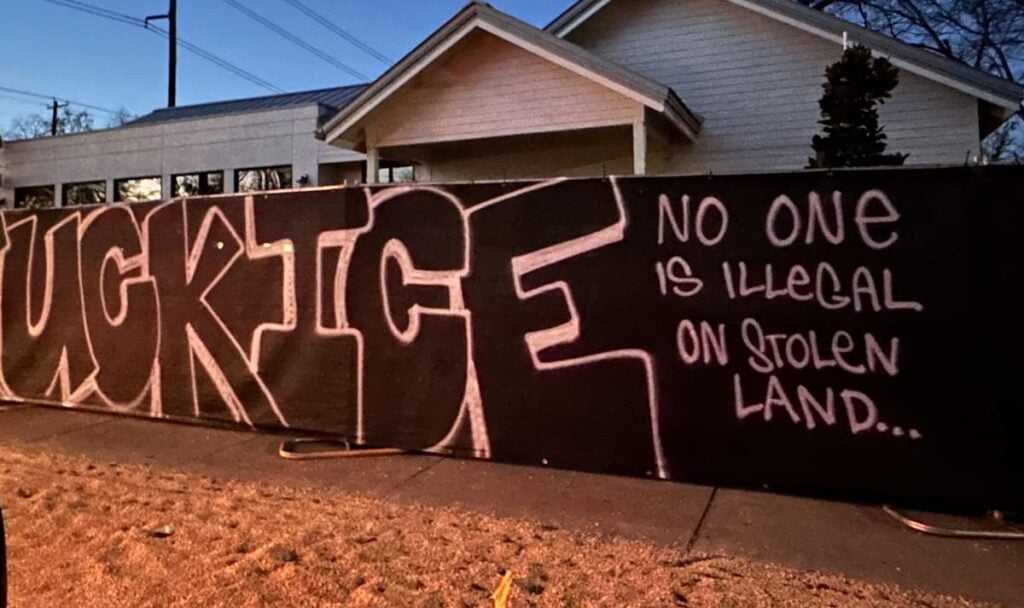
A photo taken on the east side of Austin, Texas, showing graffiti that reads “expletive ICE” followed by “no one is illegal on stolen land,” has ignited a sprawling debate online that goes far beyond immigration enforcement and squarely into arguments over history, legality, and moral responsibility.
While many commenters rallied behind the anti-ICE sentiment, the second line proved far more divisive. The phrase “stolen land,” particularly when applied to Texas, fractured what might otherwise have been a unified message. In the Reddit comment section where the image was shared, agreement on immigration criticism quickly gave way to arguments over conquest, treaties, borders, and whether calling Texas “stolen” is historically accurate, morally necessary, or politically self-defeating.
A recurring theme in the comments is that opposition to ICE is relatively mainstream within the community, while the “stolen land” framing is not. Several users argued that the added slogan diluted the message rather than strengthening it. One commenter described it as “an extra line that tries to be cute and just fractures what should be a solid front,” reflecting a broader belief that simplicity is key if a political message is meant to persuade rather than provoke.
Others echoed this sentiment more bluntly, saying that invoking stolen land immediately loses support, even among people who acknowledge historical injustices. As one user put it, many Americans can accept that governments used “crappy methods” in the past while still believing that land ownership, globally, has always been decided through conquest.
“All Land Is Stolen” vs. “That’s Not an Argument”
From there, the debate splintered into two camps. One side argued that the phrase “no one is illegal on stolen land” is intentionally broad, which is not a specific indictment of Texas, but a moral statement that questions borders altogether. According to this view, the fact that most land has a violent history is the point, not a loophole. If dispossession is foundational, then legality itself becomes suspect.
Opponents pushed back hard on that framing. Several commenters argued that saying “everyone lives on stolen land” is not a serious political argument but an abstraction that collapses under real-world implications. If all borders are illegitimate, they asked, does that mean anyone can live anywhere? Does it invalidate laws entirely? To many, the slogan sounded less like moral clarity and more like anarchism, making it easy to dismiss.
Texas, Mexico, and Competing Histories
Once Texas entered the conversation specifically, the arguments became more granular. Some commenters noted that Texas was once part of Mexico, while others pointed out that it existed as an independent republic before joining the United States. This led to back-and-forth over the Texas Revolution, Mexico’s abolition of slavery, and whether American settlers rebelled primarily to preserve slavery or in response to political centralization under Santa Anna.
Still others widened the lens further, arguing that Mexico itself had taken land from Indigenous peoples before selling territory to the United States via the Treaty of Guadalupe Hidalgo. That claim was countered by commenters who emphasized broken treaties with Native tribes, arguing that “stolen land” refers less to battlefield conquest and more to systematic violations of agreements that were supposed to guarantee Indigenous land rights.
One user suggested that legality between states does not equal moral legitimacy, especially when the people most affected were never part of the negotiations.
Morality, Responsibility, and Why the Phrase Provokes
What emerges from the comment section is less a consensus than a fault line. For critics of the slogan, calling Texas stolen land feels accusatory, impractical, and designed to provoke guilt without offering solutions. For defenders, refusing to use the term is a way to avoid uncomfortable truths, an unwillingness to grapple with how modern wealth and borders were formed.

Several commenters suggested that the real reason the phrase sparks hostility is not historical disagreement, but moral discomfort. Acknowledging stolen land, they argued, raises unsettling questions: whether anything should be done to rectify past wrongs, whether people today benefit from those wrongs, and whether ignoring them is itself a choice.
In the end, the Austin graffiti succeeded in one undeniable way: it got people talking. The phrase “expletive ICE” found broad support, but “no one is illegal on stolen land” turned the image into a lightning rod for debates about history, borders, and responsibility that remain unresolved.