North Carolina residents are ramping up pressure on their elected officials in the wake of President Donald Trump’s inflammatory social media post targeting Iran, with many constituents flooding Senate offices with emails, letters, and even handwritten postcards demanding action.
The surge follows a weekend escalation in rhetoric, where Trump issued a warning tied to the Strait of Hormuz alongside a high-risk U.S. military rescue operation inside Iran. The language of the post has sparked concern among some voters, particularly in North Carolina, where Senators Thom Tillis and Ted Budd have become focal points for constituent outreach.
Online discussions in North Carolina community forums show a growing number of residents taking direct action. Some describe contacting their representatives daily, while others are organizing more traditional methods such as mailing letters and purchasing stamps to ensure their concerns are formally logged.
Angry Citizens are Spamming Government Officials Daily
“I email the three almost every day. We all need to do this,” one North Carolina resident wrote. Others echoed the approach, framing it as a coordinated effort to flood offices with consistent messaging rather than one-off complaints.
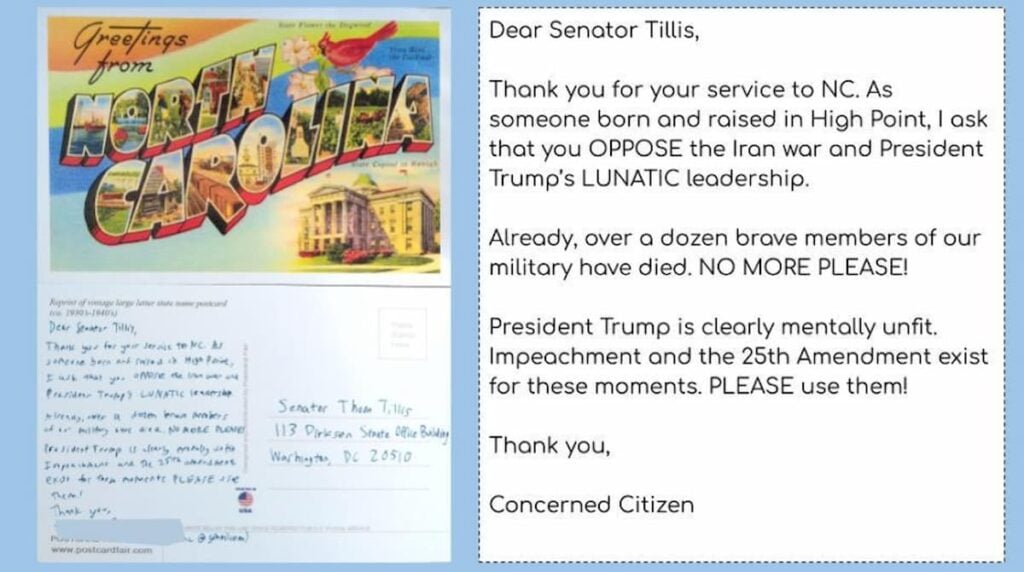
Other residents report buying stamps and sending physical letters (one pictured above), while others say they are calling daily or using multiple channels to ensure their voices are counted. The repetition is deliberate. Many believe the cumulative effect of thousands of messages can influence how staff brief elected officials.
At the center of the outreach is concern over Trump’s rhetoric and fitness for office. One widely shared message, which was the subject of a Reddit thread that exploded in popularity, sent to Senate offices reads: “He is very clearly not in control anymore. You must remove him immediately, this is very serious.” Variations of that message are being copied, adapted, and resent across the state.
Participants in the effort acknowledge that individual messages may receive generic responses or none at all. But that has not slowed the pace. Instead, it has reinforced the strategy.
“It takes five minutes to send out those emails and while it may do nothing, it also might have an effect,” one resident explained. Others explicitly say the goal is to overwhelm staff workflows, ensuring the issue cannot be ignored internally.
Not Everyone Is Convinced It’s Worth the Effort
Not everyone in North Carolina is convinced the approach will work. Critics argue that congressional offices rely on staffers and automated systems to handle high volumes of communication, limiting the direct impact on lawmakers themselves. Still, even skeptics concede that offices often track constituent sentiment through sheer volume.
For many participants, the campaign is less about immediate results and more about sustained visibility. “Doing nothing is not an option,” one commenter wrote, summarizing the mindset driving the wave of outreach.
As tensions abroad continue and political rhetoric escalates, North Carolina’s response has taken a clear form. Not protests or rallies, but relentless, repeated contact aimed straight at the inboxes and mailrooms of those in power.