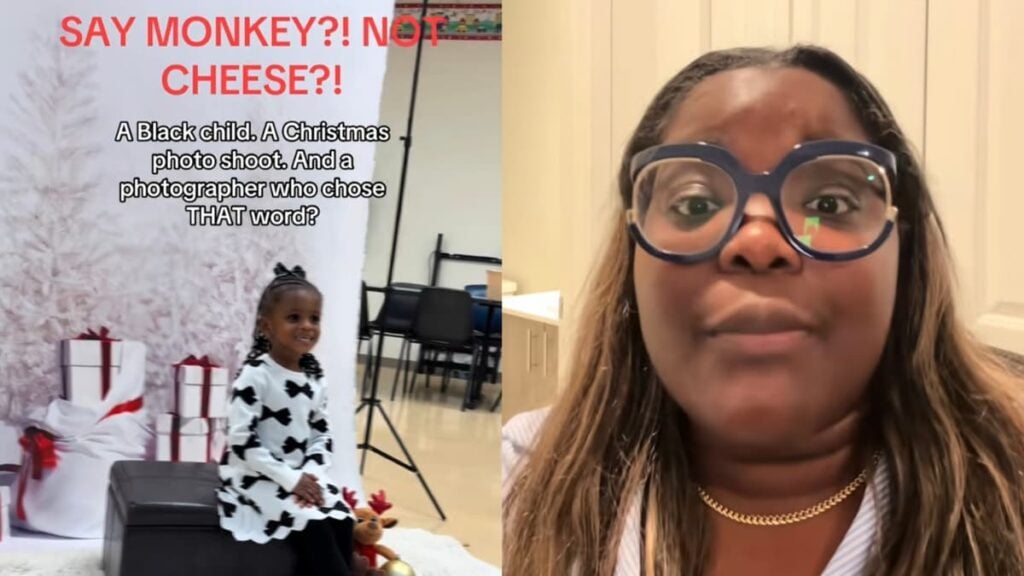
A black woman in Florida was left outraged after a white female photographer told her niece to say “monkey” while taking her pictures.
The woman, identified as Monae, shared a video that began with a clip of her niece sitting down and getting ready to have her Christmas photos taken. An adult accompanying the little girl could be heard telling her to “say cheese,” which she did. However, what upset Monae was the photographer’s decision to tell her niece to say “monkey” instead.
“SAY MONKEY?! NOT CHEESE?! A Black child. A Christmas photo shoot. And a photographer who chose THAT word?” Monae wrote across the video. She then appeared on camera to express her disbelief and question why the photographer would choose that particular word when speaking to her niece. Monae also referenced a recent racist incident involving Ole Miss students, explaining why she believed her concerns were justified.
Monae pointed out that her niece continued saying “cheese” instead of “monkey,” despite the photographer’s instructions. She then played another clip showing the photographer acknowledging the little girl’s response. “She’s like ‘I’m saying cheese,’” the photographer said.
What Happened Next
Although Monae acknowledged that she was not present during the photo shoot and could not know the photographer’s intentions, she argued that there were plenty of other words the photographer could have used. “I mean you could at least had her say Christmas, Santa, reindeer, or something like that but you had her to say monkey,” Monae said.
She then brought up the Ole Miss incident again, explaining why the photographer’s choice of words was particularly upsetting to her. “That really hit different for us, and how are y’all expect us to live with this and to live in a community where we are being compared to monkeys,” she said. Monae continued expressing her frustration, emphasizing that her niece was only in pre-K and that the photographer could have simply asked her to say the traditional “cheese.”
“I feel like this lady was wrong, and I don’t feel like I’m doing too much,” Monae said toward the end of the video. She also questioned the photographer’s choice of words in the caption, writing, “My niece said CHEESE, and I’m glad she did! But why was MONKEY the word being used in the first place? Given the racial history and what recently happened at Ole Miss, I think this deserves a conversation. Am I overreacting, or would you have questioned this too?”
Monae’s frustration stemmed from the racist history of comparing black people to monkeys, a form of dehumanization that has been used for centuries to portray them as inferior and justify discrimination and mistreatment. Although the word “monkey” is not inherently racist, comparisons between black people and monkeys carry deeply offensive historical associations. This context helps explain why Monae found the photographer’s choice of words troubling, even as she acknowledged that she could not determine whether the remark was intentional.
Viewers Slam Florida Photographer Over Word Choice
Many viewers online criticized the photographer and defended the Florida woman for expressing her frustration over the incident. They agreed that the choice of words was inappropriate and believed that it may have been racially motivated. “Yea absolutely not,” one person wrote, expressing disapproval of the photographer’s remark. Another commenter insisted that Monae was justified in questioning what happened, saying, “NOPE, not reaching AT ALL!!! Stop allowing these maggots to gaslight y’all. They meant what they said. It was LOUD.”
Others continued expressing outrage over the photographer’s choice of words, questioning why she would ask the little girl to say “monkey” during a Christmas photo shoot. “Monkey??????????????????? Sista I would’ve been under the jail right now bout my niece,” one person wrote, expressing how strongly they would have reacted. Another commenter questioned the choice of word, saying, “like monkey??? Out of everything? No.” Someone else expressed surprise at the unusual instruction, adding, “I’ve never heard of that literally.”
The controversy has prompted a discussion about racial sensitivity and the importance of choosing words carefully, especially around children. While the photographer’s intentions remain unclear, the incident highlights how certain expressions can carry painful historical associations and cause offense, even when no harm may have been intended.