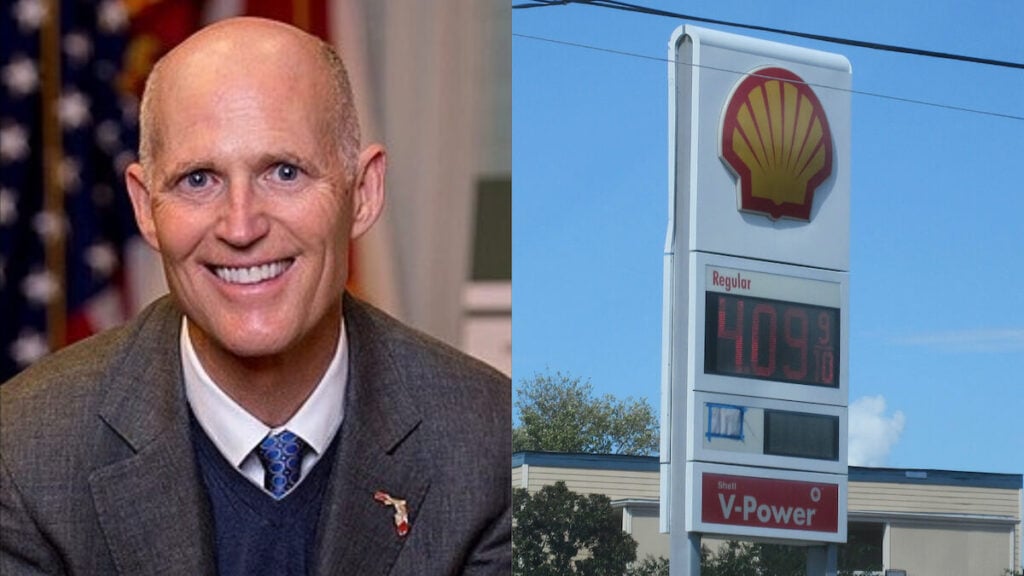
Florida Sen. Rick Scott rejected the argument that the Iran war was a choice while discussing rising gas prices. He acknowledged frustration over high gas and diesel prices but contrasted those costs with what he described as nuclear danger. Scott said he did not want his children or grandchildren “killed by a nuclear weapon.”
During an interview on CNBC, a host raised criticism that the war had worsened affordability despite Republican promises. Scott rejected that framing and said Iran had been close to obtaining a nuclear weapon. Iran had enriched uranium to 60%, well above levels typically used for civilian nuclear power but below the roughly 90% generally considered weapons-grade. However, that did not mean Iran already possessed a nuclear weapon.
“It wasn’t a war of choice,” Scott said. He argued previous presidents had appeased Iran and accused the country of killing Americans for decades. He said action was necessary if Iran intended to obtain a nuclear weapon and use it against Americans.
Scott then turned to energy costs. He said nobody likes war or high gas and diesel prices. However, he again contrasted those concerns with the risk he associated with nuclear weapons.
“I don’t like high gas prices, but I don’t want to be killed by a nuclear weapon,” Scott said.
He also defended President Donald Trump’s energy approach, saying the administration was increasing domestic oil and gas production. Scott added that progress would take time.
Scott has since gone even further in calling for military action against Iran. During an interview with a Florida television station on October 7, the senator said he thought the U.S. should “bomb the living daylights out of them” and push for regime change.
When asked whether he was suggesting the use of nuclear weapons, Scott said he didn’t believe that was necessary. Instead, he argued that the U.S. had the military capability to destroy Iran’s leadership and military infrastructure.
Scott’s call for more aggressive military action also comes as the Trump administration appears to be holding off on additional strikes, at least temporarily. Trump said on October 8 that the U.S. would not attack Iran before the November midterm elections as negotiations continue between the two countries.
That leaves Scott pushing for tougher military action as the administration publicly points to talks as a possible path to ending the conflict.
Rick Scott Faces Backlash Over Iran War, Gas Prices and Nuclear Warning
Scott’s comparison drew ridicule from users who rejected the choice between higher fuel costs and the threat he described.
One response mocked the framing directly: “Now it’s ‘pay $6 for diesel or you might get nuked.’ Fear is the entire sales pitch.” Another pushed back on the either-or argument, writing, “As if there are only 2 options. I like cheap gas, solar power, electric cars, and not being blown up.”

Others leaned into sarcasm. “Rick Scott’s whole energy plan is a choose your own doomsday book,” one user wrote.
Scott’s latest comments make it clear he hasn’t backed away from his argument on CNBC. Despite acknowledging that the Iran war has contributed to higher prices, the Florida senator continues to argue that confronting the country is necessary because of the threat he believes it poses.
Trump’s decision to hold off on additional attacks before the midterm elections adds another layer to that debate. For now, negotiations continue while Americans still deal with one of the consequences that started the argument in the first place: higher prices at the pump.