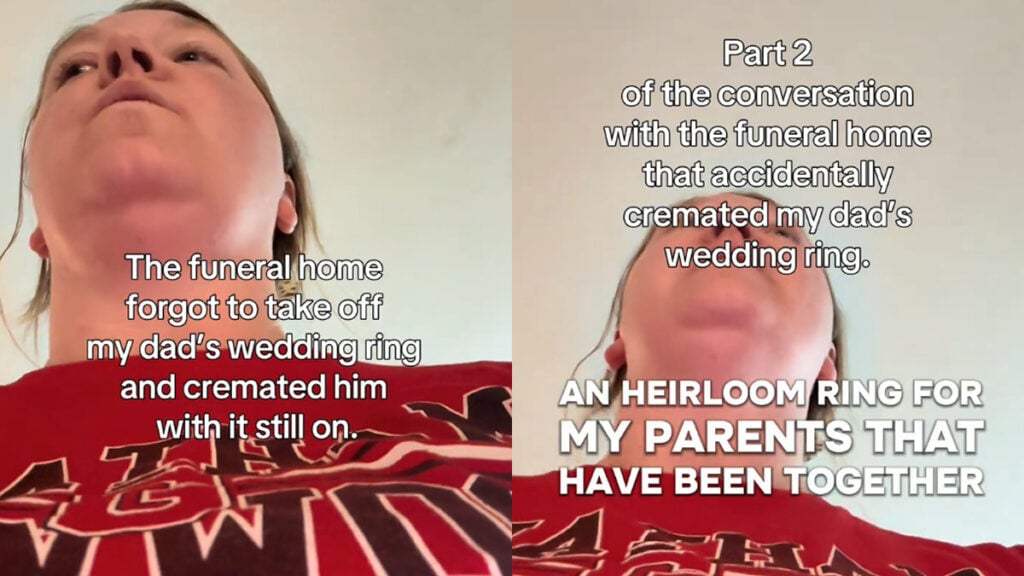
A Florida woman has drawn widespread attention on TikTok after sharing her frustration over what she says was a devastating mistake by a funeral home. According to her, staff failed to remove her late father’s 50-year wedding ring before his cremation, leaving her without one of the family’s most treasured keepsakes. The emotional story has sparked questions about funeral home procedures and accountability.
The video was posted to the Florida woman’s TikTok account, @kirby.amelia, where she has documented her grief journey following her father’s death. Her series of videos has resonated with many viewers, prompting this latest update to spread quickly across the platform, with thousands of comments discussing what happened.
In the video, the Florida woman explained that the wedding ring had been worn by her father throughout his 50-year marriage to her mother and had become a cherished family heirloom. She said her father passed away just one week before Father’s Day and one day before his wedding anniversary, making the loss even more painful.
According to her, the funeral home had agreed to return the ring after the cremation process, but instead informed her that it had been cremated along with her father’s body. She said staff offered little explanation beyond acknowledging the mistake, leaving her feeling that one of the last meaningful connections to her father had been taken away.
The creator also clarified that there had been no viewing, funeral service, or casket before the cremation. Because of that, she said the responsibility for removing and returning the ring rested entirely with the funeral home under their agreement. She expressed anger over what she described as an avoidable mistake and said the loss went far beyond the ring’s monetary value because of its sentimental significance.
Viewers Question Funeral Home’s Actions in Florida
Many TikTok users responded with sympathy while also questioning how the cremation process had been handled. A large number of commenters, including people who identified themselves as funeral directors, crematory operators, and mortuary science graduates, argued that standard procedures appeared inconsistent with the Florida woman’s account. Several claimed that cremations generally cannot proceed without required documentation and encouraged her to consult an attorney. Others suggested filing a police report if proper procedures had not been followed. “They can’t legally cremate without the death certificate. I’d call a lawyer,” one user wrote.
Another major topic centered on whether the wedding ring had actually been destroyed. Many commenters disputed the funeral home’s explanation, saying gold and most wedding ring metals typically survive cremation. Some claimed the ring should still exist, either intact or as a melted piece of metal, citing gold dental work and other metal objects that often remain after cremation. Others urged the Florida woman to demand that the funeral home recover the ring instead of accepting that it had been reduced to ashes. “They owe you more than money,” another commenter wrote.
The discussion also turned to funeral home policies regarding jewelry. Many viewers said families are normally asked whether they want jewelry removed before cremation, while others shared experiences of hospitals returning valuables before transferring a loved one into funeral home care. After the Florida woman explained that the funeral home had been responsible for returning the ring, many commenters argued that the responsibility for the loss rested solely with the facility.
One missing wedding ring has now become a much bigger conversation about grief, trust, and whether a family’s final wishes were truly honored. Sometimes the smallest object can carry the biggest memories.