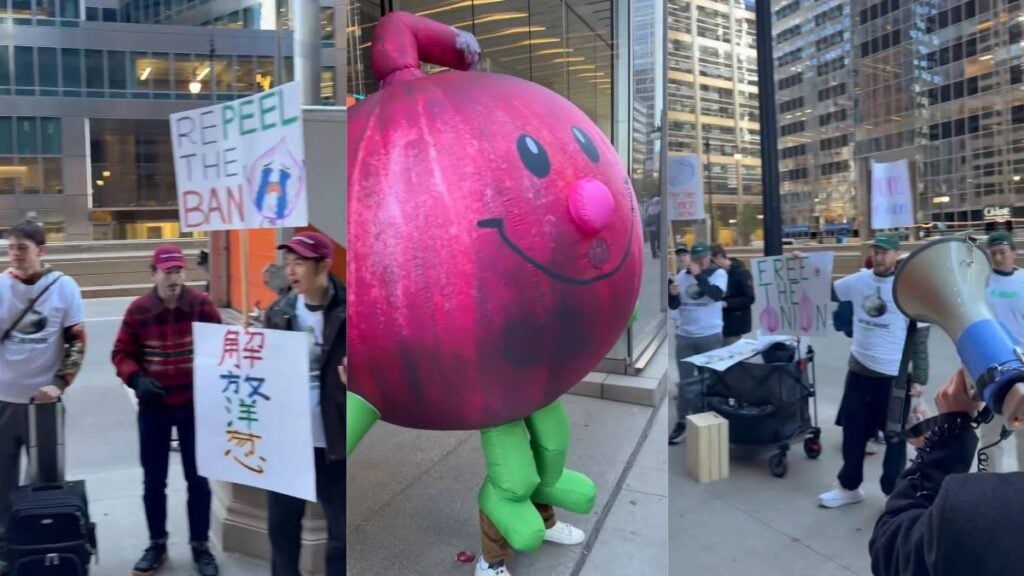
University of Chicago students took their unusual protest to downtown Chicago, Illinois, armed with cardboard signs, a megaphone, and an enormous inflatable onion costume. Their demonstration targeted a decades-old federal law that bans onion futures trading.
The protest took place on October 19, 2026, outside the Chicago Mercantile Exchange (CME Group) headquarters. Videos shared by @foronionfutures and reshared by @PopBase on X show students holding signs reading “Free the Onion” and “I Love Justice.” One participant even dressed as a giant red onion with a smiling face, while others carried an American flag featuring an onion design.
For Our Futures, an unregistered student organization made up of University of Chicago students, organized the demonstration to urge Congress to repeal the Onion Futures Act of 1958. The group argues that the decades-old law is outdated and that allowing onion futures trading again could give farmers and buyers another way to protect themselves against sudden price changes.
However, the protest wasn’t entirely student-funded. The Chicago Maroon later reported that prediction-market company Kalshi sponsored the event, paying for a bus to bring students from campus while also providing breakfast and branded merchandise. For Our Futures co-founder Adam Ash told the student newspaper that “four or five” Kalshi affiliates also participated.
Kalshi’s interest isn’t as strange as it might initially sound. Onions aren’t the only thing covered by the unusual law. Congress amended the Onion Futures Act in 2010 to also prohibit futures contracts based on motion-picture box-office receipts, giving prediction-market companies their own reason to support changing the law.
The onion ban itself dates back to an infamous market manipulation scheme involving traders Sam Siegel and Vincent Kosuga in the 1950s. During the episode, the price of a 50-pound bag of onions plunged from roughly $2.75 to just 10 cents, causing major losses for growers and helping prompt Congress to act. President Dwight Eisenhower ultimately signed the Onion Futures Act into law in 1958.
Futures contracts generally allow buyers and sellers to lock in prices ahead of time, helping businesses manage the risk of sudden price changes. Supporters of repealing the onion ban argue that growers should have access to the same type of risk-management tools available to producers of other agricultural commodities.
For Our Futures has previously promoted its campaign by handing out raw onions and collecting petition signatures at the University of Chicago and Northwestern University. Taking the campaign to CME headquarters brought the protest to the historic center of the onion futures market that the nearly 70-year-old law effectively shut down.
Despite the serious economic argument behind it, the demonstration remained playful. Students smiled, chanted, posed with handmade signs, and marched alongside their giant onion mascot, turning an obscure piece of financial law into a protest passersby couldn’t ignore.
Internet Reacts To Illinois Students Demanding Onion Trading Freedom
Online, the video sparked amusement and confusion. One commenter joked, “Every other campus protests for free tuition. UChicago kids are marching downtown for the right to short an onion. Milton Friedman would be proud.” Another wrote, “the most uchicago protest of all time.”
Some viewers were surprised by the law’s wider history, with one commenting, “Im more suprised by the fact that onions had something to do with the box office.”
Others were less impressed. “These people have too much time on their hands,” one person wrote, while another questioned whether the demonstration was genuine, saying, “This has to be an econ class project, not a real protest.”
The onion campaign may be getting more serious attention than its costumes and signs suggest. MarketWatch reported that Commodity Futures Trading Commission Chairman Michael Selig has supported the students’ effort. Whether Congress will take another look at the nearly 70-year-old ban remains another question, but the students have already turned one of America’s more obscure trading restrictions into an unlikely national conversation.