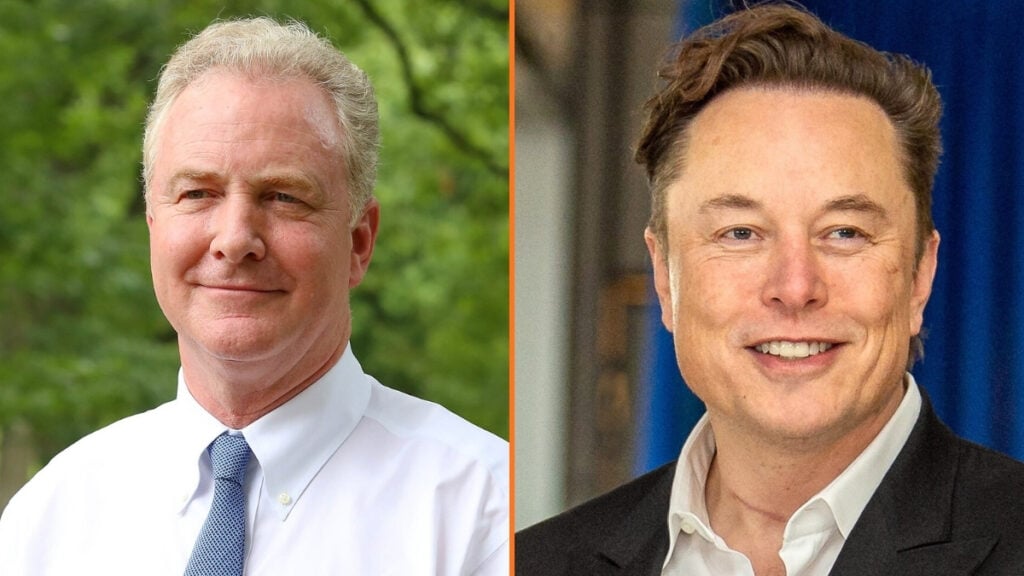
Maryland Senator Chris Van Hollen is drawing criticism after questioning how billionaire Elon Musk can spend hundreds of millions of dollars on federal elections despite his companies receiving billions in government contracts. The Democrat says a loophole in federal campaign finance laws allows this to happen, but commenters are questioning whether his proposed solution would apply equally to wealthy political donors across party lines.
Van Hollen raised the issue in an X post that points to existing restrictions on political contributions from businesses that hold federal contracts. However, the senator’s decision to single out Musk quickly prompted accusations of selective enforcement, with critics arguing that the distinction between an individual and a corporation is central to the debate.
In his post, Van Hollen asked why Musk has been able to spend so heavily on elections when companies associated with him receive substantial federal funding. He suggested that the answer lies in a loophole he is working to close, framing the issue as a question of whether government contractors should be able to influence the politicians overseeing their contracts.
The controversy centers on the difference between contributions made by federal contractors and political spending by individuals connected to those businesses. Federal campaign finance rules prohibit certain contributions by federal contractors, but those restrictions do not automatically prevent an executive or owner from spending personal funds on political activities.
That distinction has become particularly relevant to Musk, whose companies include SpaceX, a major federal contractor, and OpenAI, which has a multi-year partnership with the General Services Administration. He has also personally supported political candidates and organizations, most notably as the head of the now-dissolved federal initiative, The Department of Government Efficiency.
Others argue that restricting an individual’s political spending because of their business connections could raise significant questions about free speech and equal treatment under campaign finance law. Those concerns were reflected throughout the replies to the X post, where commenters repeatedly asked whether the same standards would apply to donors associated with Democratic campaigns.
Comments and Reactions to Chris Van Hollen’s Campaign Finance Proposal
Many commenters challenged Van Hollen’s interpretation of campaign finance restrictions, arguing that Musk’s personal spending should not be confused with contributions made directly by his companies, with one person writing, “Elon Musk, whose COMPANIES get billions. He isn’t the company.” However, it is important to note that, according to Fed-Spend, roughly 20% of total revenue earned by SpaceX comes from the US government.
Other critics questioned whether Can Hollen would apply the same proposed restrictions to Democratic donors and executives whose businesses receive federal funding. “Some of the billionaire families who contributed to Democrats at $488 million dollars this midterm cycle have received government contracts or grants. Is this for them too?” one commenter asked, although the figure was not independently established in the discussion.
According to Reuters, in comparison, SpaceX alone has secured $8.5 billion in government contracts in 2026, with $900 million earned in Q1 alone. With billions in taxpayer-funded contracts at stake, the debate over political spending by federal contractors is unlikely to go away anytime soon.