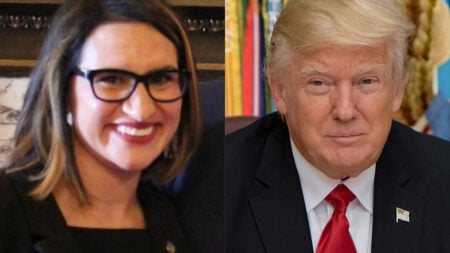
New Jersey Rep. LaMonica McIver recently said she was “100 percent certain” the Trump administration would retaliate against her as she continued criticizing conditions at Newark’s Delaney Hall immigration detention facility. Days later, a divided federal appeals court handed the congresswoman a major setback in the criminal case stemming from her previous confrontation with federal officers at the same facility.
The August 26 ruling allows two of the three federal counts against McIver to proceed, rejecting her argument that her alleged conduct was protected by congressional immunity. But the decision also exposed disagreement among the judges over McIver’s separate allegation that the prosecution itself is retaliatory.
The remarks came during an MS NOW interview after McIver and other lawmakers visited the detention facility in New Jersey.
The group spoke with more than 20 detainees about conditions inside, which McIver described as “horrible.” Detainees reported receiving too little food, including meals that were spoiled or stale.
She also described complaints about access to healthcare. One man said he needed mental health care but could not receive it. Women reported lacking access to OBGYN care and feminine products.
McIver said detainees also faced uncertainty about what would happen with their cases. Some had been detained at asylum hearings or immigration court proceedings, she added.
Others had approved student or work visas, according to McIver. She said the accounts confirmed that the facility “really should be closed.”
McIver and her colleagues have asked congressional oversight and judiciary officials to fully investigate the facility. They also requested that it be shut down.
The interview then shifted to McIver’s own legal situation. The host noted her ongoing charges and asked whether returning to the facility raised concerns about retaliation.
“Oh, I’m 100 percent certain,” McIver replied.
She accused the administration of prioritizing “cruelty” and “retaliation.” She also accused it of trying to silence its critics.
McIver responded to the ruling by declaring, “this is not over,” and her attorneys said they were evaluating their options. The divided decision also touched on the retaliation argument McIver raised during the interview. Judge Thomas Ambro, who partially dissented, argued that the unusual circumstances surrounding the case warranted allowing McIver to seek evidence supporting her claim of vindictive prosecution. The majority did not agree that the issue could be reviewed at this stage, meaning McIver’s retaliation allegations remain unresolved rather than established by the court.
‘No One Is Above the Law’: Critics Rip LaMonica McIver After She Predicts Trump Retaliation
That retaliation claim quickly became a focus of criticism, particularly among users who argued that McIver should face the legal process regardless of her position.
“Always playing the victim,” one user wrote. Another invoked accountability, writing, “No one is above the law. I think I heard that once.”
Others were more explicit about the pending case. “She did the crime she needs to do the time!! She was to respect their authority not attack them!” one response stated. McIver has not been convicted of the charges and has pleaded not guilty.
Another wrote, “I want to see her in prison. Make an example of her.”
Not every response treated the allegations as settled. “Name-calling doesn’t make the legal process any clearer. Everyone deserves due process regardless of political office,” one user stated.

Another emphasized the distinction between pending charges and a conviction: “A federal appeals court kept most of the case against Rep. LaMonica McIver alive but this isn’t a conviction.”
For now, McIver’s prediction of retaliation remains an allegation, but the criminal case against her is very real. A federal appeals court ruled this week that most of the case can move forward, rejecting her argument that the alleged conduct was protected by congressional immunity. McIver has pleaded not guilty and maintains that the prosecution is politically motivated. The courts will ultimately determine whether prosecutors can prove their allegations.