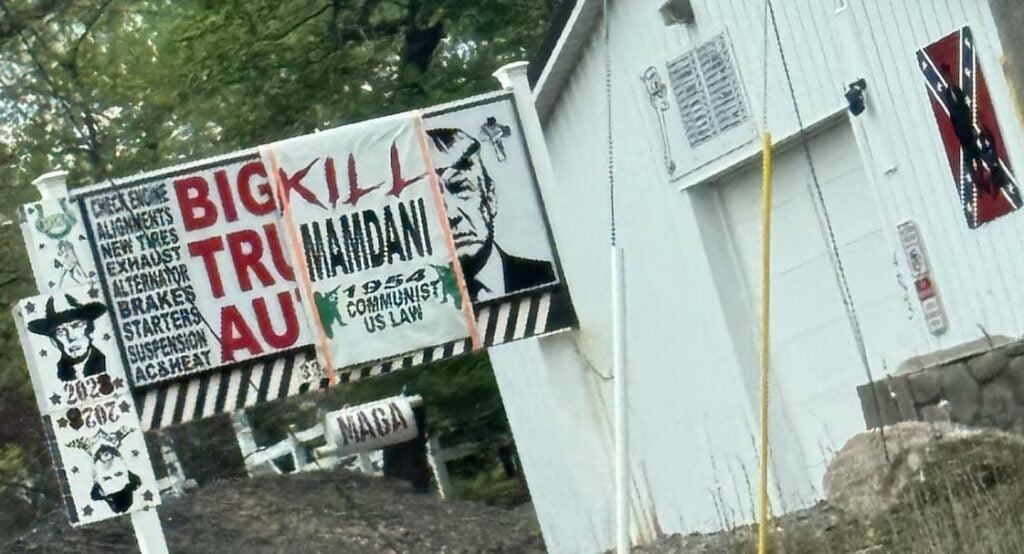
A roadside mechanic shop in Seville, Ohio, is drawing widespread criticism after images of a politically charged sign began circulating online. The display, mounted prominently outside a small white building, features inflammatory messaging targeting New York City Mayor Mamdani, alongside crude graphics and a call for violence.
The sign itself is hard to miss. Large block lettering spells out “KILL MAMDANI” accompanied by stenciled portraits and aggressive slogans. Nearby, a Confederate flag hangs on the building, reinforcing the confrontational tone. According to locals, a noose that had previously been part of the display has since been removed, though its reported presence has only intensified concern.
Online, particularly in a thread over on the Ohio subreddit that quickly gained traction, residents and observers expressed disbelief. The central question repeated throughout the discussion is simple: why target a mayor from another state?
“Apparently the mayor of New York City has further reach than I thought,” one commenter wrote, questioning how a local Ohio business could feel directly impacted by a politician hundreds of miles away.
A Local Business, A National Hot Potato
The controversy has become less about one sign and more about what it represents. Commenters repeatedly point to a disconnect between the shop’s location and its messaging. Mamdani, a Muslim mayor in New York City, has no direct governance over Ohio, yet the rhetoric suggests a deeply personal animosity.
“I asked how Mamdani being mayor in another state will impact him,” another user shared. “They’re so easily pushed to a fear response.”
That fear, according to several participants in the thread, may be rooted in broader political and cultural anxieties rather than tangible policy effects. Others were more blunt, arguing that the hostility crosses a line into dangerous territory.
“They want a man across the entire country that they’ll never even meet to be killed,” one commenter wrote. “That’s how ridiculous their racism is.”
Beyond the political implications, some locals questioned the business itself. Multiple users claimed they had never seen cars at the shop, while others alleged confrontational behavior from its operators online. Though these claims remain anecdotal, they add to the perception that the establishment is more focused on messaging than mechanical work.
There is also a broader historical irony not lost on residents. Ohio played a key role in the Underground Railroad and the Union war effort, making the presence of Confederate imagery particularly jarring for some. “These people are beneath the dignity of our history,” one commenter noted.
For now, the shop remains standing, its signage continuing to attract attention both locally and online. What might have once been dismissed as fringe expression has instead become a focal point for a larger conversation about political extremism, misinformation, and how far rhetoric can go before it becomes something more serious.