
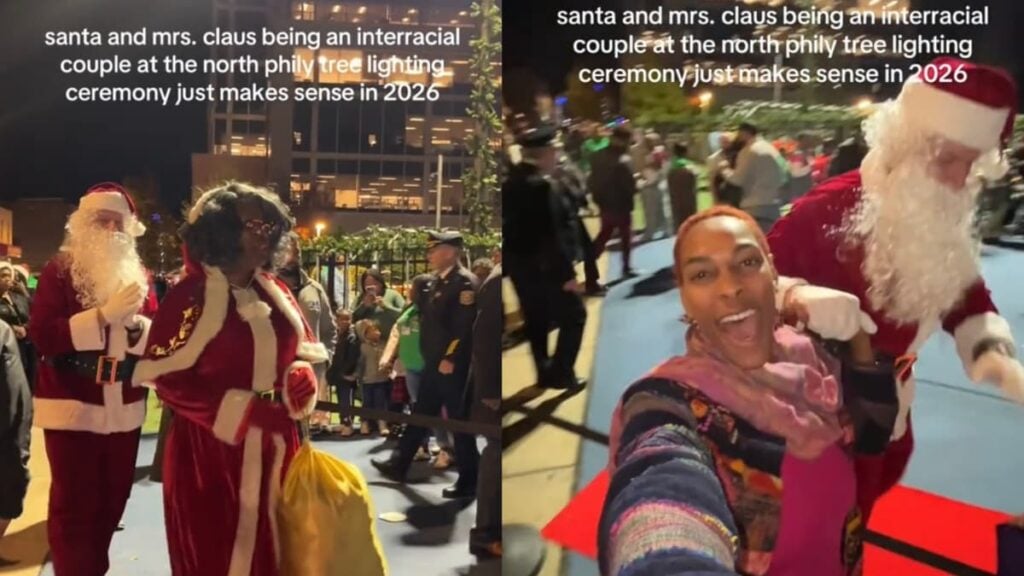
Outrage erupted online after a black woman portrayed Mrs. Claus during a tree-lighting ceremony in Pennsylvania.
The controversy began when TikTok user @traveling.tee shared a video showing Santa Claus and Mrs. Claus at the celebration. In the footage, a white man appears to be portraying Santa Claus alongside a Black woman dressed as Mrs. Claus.
The TikTok user viewed the situation as something worth celebrating. “Santa and mrs. Claus being an interracial couple at the north Philly tree lighting ceremony just makes sense in 2026,” she wrote over the video while filming the actors. Toward the end of the clip, she turned the camera toward herself as Santa and Mrs. Claus walked past. She also expressed her excitement in the caption, writing, “santa and his black queen IKTR!”
However, not everyone shared her enthusiasm. The video was later reposted by X user @WallStreetApes, who criticized the decision to have a black woman portray Mrs. Claus. “Santa and Mrs. Claus are now an interracial couple at the North Philly Tree Lighting. Not even Mrs. Claus is safe from being race swapped…. Isn’t it interesting how it’s only white people who get race swapped and always portrayed in interracial relationships like this….,” they wrote.
The situation sparked outrage among some social media users who objected to seeing a black woman portray Mrs. Claus alongside a white Santa Claus. Critics argued that the traditional depiction of Mrs. Claus as a white woman was being changed to promote racial diversity and interracial relationships. Some viewed the casting as an unnecessary alteration of a familiar Christmas character.
Others accused the organizers of deliberately replacing white characters with people of other races. However, the backlash also raised questions about racism and representation. This is particularly since there is no requirement for Mrs. Claus to be portrayed by a white woman. Supporters of the casting saw nothing controversial about it. They argued that Santa Claus and Mrs. Claus are fictional Christmas characters and that the actors’ race should not matter.
Viewers Outraged After Black Pennsylvania Woman Plays Mrs. Claus
Many viewers online expressed outrage over the video showing a black woman portraying Mrs. Claus in Pennsylvania. They argued that a white woman should have played the character. Some reactions also included racist remarks, with commenters criticizing the representation of black people in traditional Christmas celebrations. “It is important to pretend that 7% of the population is more influential and larger than they actually are,” one person wrote.
Another commenter accused the casting of being cultural appropriation, saying, “It is cultural appropriation… They screaming if a white girl gets braids, so maybe they should get their own culture and traditions instead of stealing ours… They can’t keep telling us we have no culture and hating on us, and then gave the nerve turn around and appropriate our culture and traditions.”
Others continued to criticize the casting, arguing that traditional folklore characters from non-European cultures were not subjected to similar changes. “I don’t see African, Asian, Indigenous, or other non-European traditional folklore characters being race swapped to appeal to whites… because whites would never do that,” one person wrote.
However, not everyone agreed with the backlash. Some criticized those who objected to a black woman portraying a fictional Christmas character. “You’re complaining about race-swapping a fictional character like yall aren’t known for constantly doing the same to a certain dead guy,” another commenter said. They appeared to reference depictions of Jesus Christ as a white man.
The controversy has raised questions about racial representation. That is also why casting a fictional Christmas character generated such strong reactions. Some argued that Mrs. Claus should maintain her traditional appearance. Others questioned why her race mattered in a celebration intended to bring people together. The disagreement also highlighted how racial prejudice can influence public reactions to diversity. This is even true during holiday events meant to spread joy and celebrate the Christmas spirit.