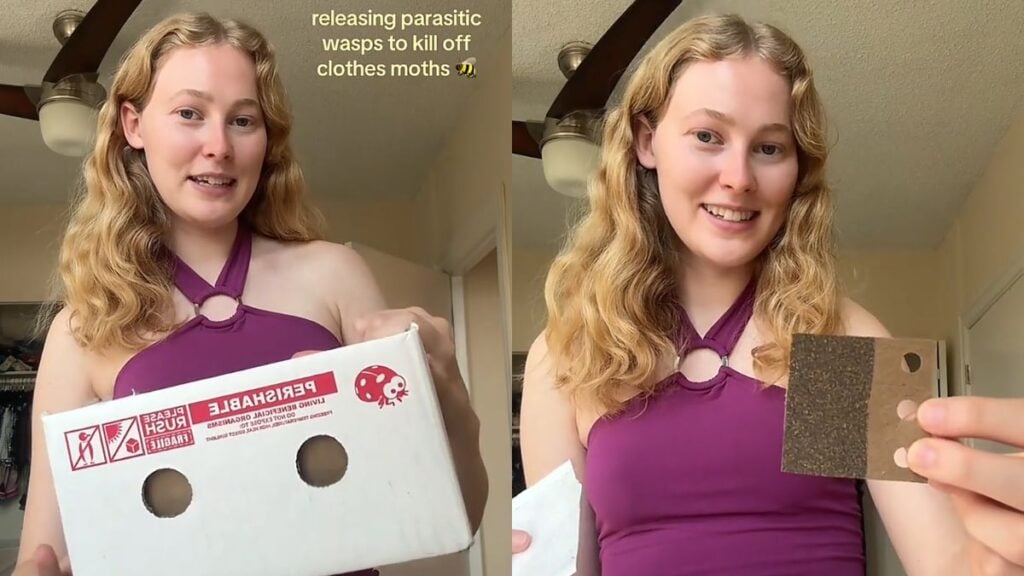
A Washington, D.C., woman’s battle with clothes moths took a serious turn after she found holes in her vintage wardrobe, including a Taylor Swift dress. Her solution was considerably more unusual than replacing a few moth-eaten clothes: she brought 10,000 tiny parasitic wasps into her home and unleashed them on the infestation.
Julia, who posts as julesisthrifty, shared her unusual pest-control experiment on TikTok. The vintage fashion enthusiast admitted releasing 10,000 parasitic wasps into her closet sounded “a little scary,” but said she was “super excited” to unleash the tiny “bad boys” on her clothes moth infestation.
“According to the internet, these eggs will hatch slowly, and then the wasps actually lay eggs inside of the moth eggs, and that basically kills off the moth,” she explained. As bizarre as it sounds, that’s essentially how the biological-control method works.
The developing wasps arrived inside parasitized moth eggs spread across three small hangers. Julia said some were already beginning to emerge, so she placed the hangers inside her closet and cotton shirt drawer.
“Allegedly, they are supposed to die off within a couple of weeks once they run out of food, aka the moths that they’re killing,” the Washington, D.C., woman added. She wished them luck, saying, “Good night, wasps.”
‘Mothballs Weren’t an Option?’: Viewers Question the Wasp Army
Despite the alarming number, these aren’t the type of wasps most people picture buzzing around a picnic. Trichogramma wasps are roughly 1 millimeter or smaller and can’t sting people.
One person asked, “Mothballs weren’t an option?” Interestingly, mothballs aren’t necessarily the easy alternative the comment suggests, either. Experts recommend using them only inside airtight containers because their vapors can pose risks to people and pets.
Another one commented, “I don’t see how this is possibly a good idea.”
Other viewers, meanwhile, argued that Julia was doing the right thing. One said, “Yup. My brother had pantry moths. The parasitic wasps are the only way.” Another one wrote, “But like, do they sting you?” to which Julia responded, “Nope! They’re harmless to humans and pets.”
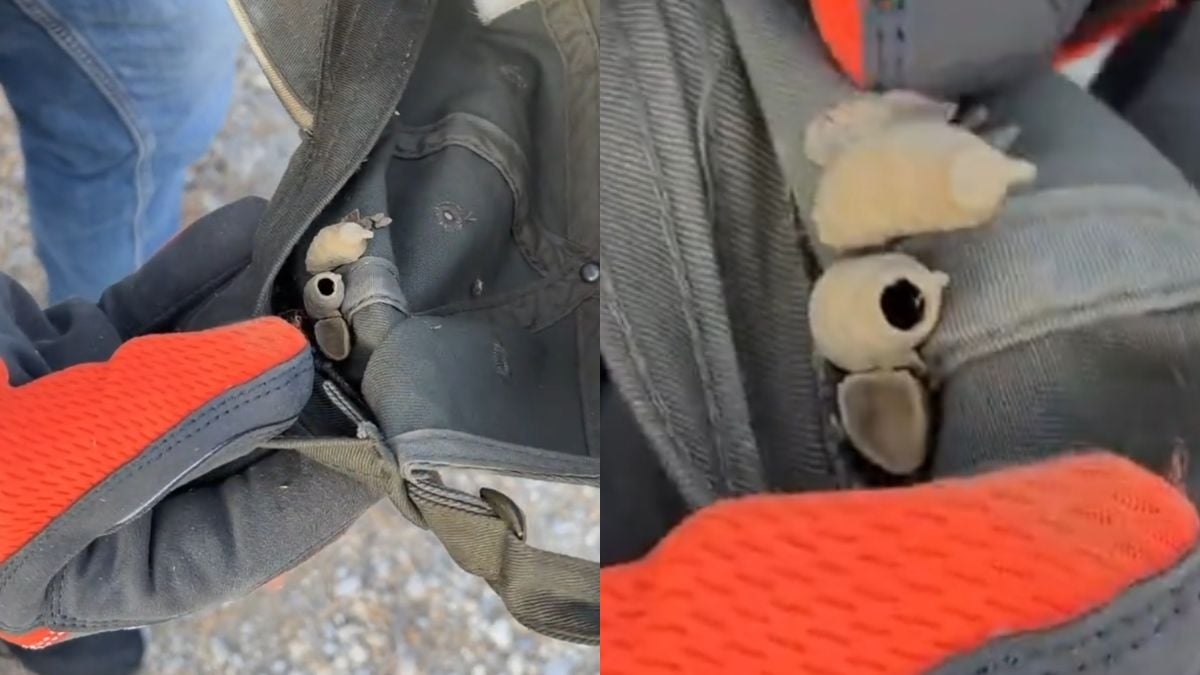
Julia has promised to update her followers on whether her tiny wasp army actually wins the battle. And despite how horrifying “10,000 wasps in my closet” sounds, the method itself is backed by science: parasitoid wasps really are used to kill moth eggs. Now she just has to find out whether her 10,000 new roommates can save her vintage wardrobe.