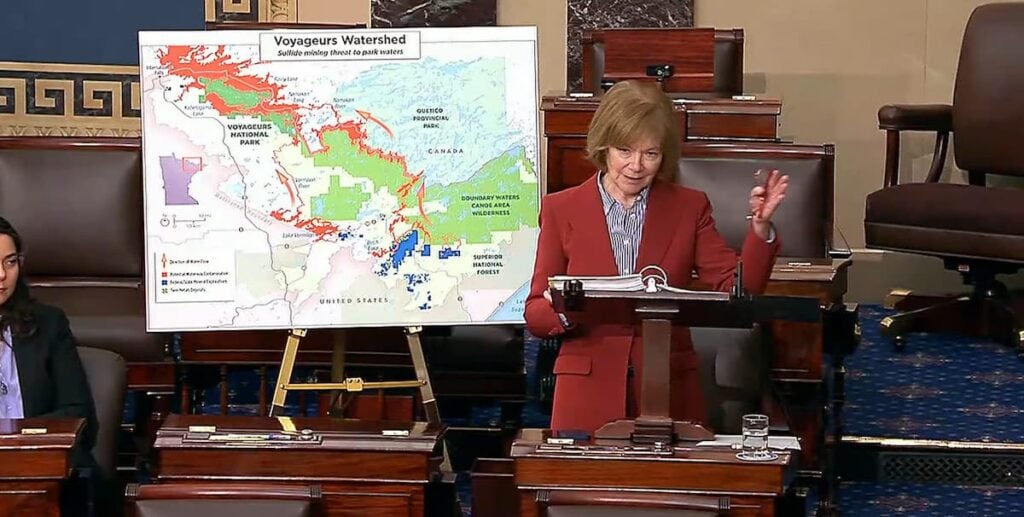
Minnesota’s long-running battle over the future of the Boundary Waters Canoe Area Wilderness reached a new flashpoint this week, as Senator Tina Smith took to the Senate floor to push back against efforts to roll back federal protections tied to a proposed mining project.
In a speech framed around environmental stewardship and economic skepticism, Smith argued the project would ultimately benefit foreign interests more than American workers. She warned that extracted minerals could be sent overseas for processing before being sold back on the open market, undercutting claims that the effort aligns with “America First” priorities.
Smith’s message was blunt. The issue, she said, is not mining itself, but location and consequence. The Boundary Waters, one of the most protected and visited wilderness areas in the United States, represents a line she and others are unwilling to cross. She urged colleagues to reject the resolution, emphasizing that public lands should not be leveraged for what she described as limited domestic gain and significant long-term risk.
Senator Amy Klobuchar followed, reinforcing concerns about the legislation’s procedural mechanism and its broader implications for public lands nationwide. Drawing on her family’s mining roots, Klobuchar framed the debate as one that requires both respect for labor history and adherence to science-based review. She questioned whether the current push reflects either.
Local Reaction Boils Over
Back in Minnesota, reaction has been unfiltered. In local online communities, such as the Minnesota subreddit, discussion lit up following Smith’s remarks, with many users expressing relief that the legislation is facing resistance.
“Good. Foreign mining on that beautiful land. Just to buy it back from China. Why are Republicans are chuds?” wrote one commenter, capturing a sentiment that quickly gained traction.
Others focused on the economic contradictions. “It’ll cost us money to mine our own stuff using a mostly automated mine that provides few jobs but kills thousands of others,” another user argued, pointing to concerns about long-term regional impact.
Skepticism over who ultimately benefits from the project surfaced repeatedly. “Profits disguised as patriotism,” one post read, while another added, “This isn’t about northern Minnesota. It’s about profits for companies.”
Some residents, particularly those in northern parts of the state, voiced frustration with political representation. “It’s always nice when he says this isn’t about the place and people I’m supposed to represent,” one Ely-based commenter said, referencing remarks from Rep. Pete Stauber supporting the resolution on national security grounds.
Despite the heated rhetoric, a throughline remains clear. For many Minnesotans, the Boundary Waters fight is not abstract policy. It is local, immediate, and deeply tied to identity. As the Senate vote looms, that tension between national strategy and regional consequence is only becoming more pronounced.