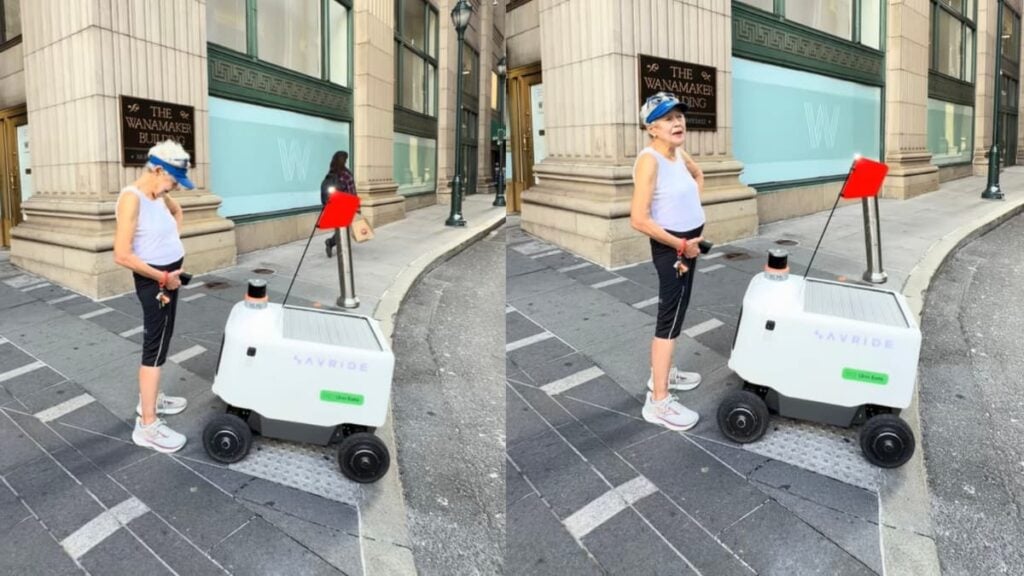
An older Pennsylvania woman became the target of online backlash after deliberately standing in front of a food delivery robot and refusing to let it pass because she believed the technology was taking people’s jobs.
A passerby named Ley filmed the unusual standoff, telling the woman, “Miss, you can’t block that. You aren’t allowed to do that.” But the woman had no intention of moving.
Instead of listening to Ley, the woman continued blocking the robot. “It’s gonna wait me out, and then they are gonna find an alternate food,” she said, apparently referring to whoever had ordered the delivery.
Ley argued that someone had already paid for the food and could even be sick and waiting for it. The possibility didn’t change the woman’s mind.
“I have no regrets,” she responded.
“These things are taking people’s job,” the woman added.
“But also it may be somebody’s food who’s sick. You can’t do that. They may be waiting on it,” Ley countered. The woman dismissed that possibility, arguing that Ley was imagining a scenario that might not actually be true.
The two continued going back and forth over whether the delivery robot was costing someone a job. The video eventually ended with Ley telling the woman, “You’re a nasty spirit, that’s what you are.” It remains unclear how long she continued blocking the robot or whether the delivery eventually reached its customer.
Delivery robots aren’t exactly legal nobodies in Pennsylvania. State law classifies authorized personal delivery devices as pedestrians. The law allows them to operate on sidewalks and crosswalks, but the robots must yield to pedestrians and cyclists.
‘Being a Karen to a Robot Is Crazy’: Viewers Pick Sides
The bizarre standoff left viewers divided over who was in the wrong. “Being a Karen to a robot is crazy,” one person wrote, while another concluded, “People are so bored and miserable.”
Others thought the woman had a point, even if they disagreed with her method. “But I mean she not wrong, robots are taking our jobs. The company could easily hire humans,” one viewer argued. Another put their allegiance more simply: “you cannot be siding with the robots.”

Pennsylvania law may recognize delivery robots as pedestrians, but this one apparently met a human who wasn’t interested in sharing the sidewalk. Whether the woman’s one-person protest accomplished anything remains unclear, as the video ends before revealing whether the robot finally made it past her, or whether someone’s dinner had to find another route.