
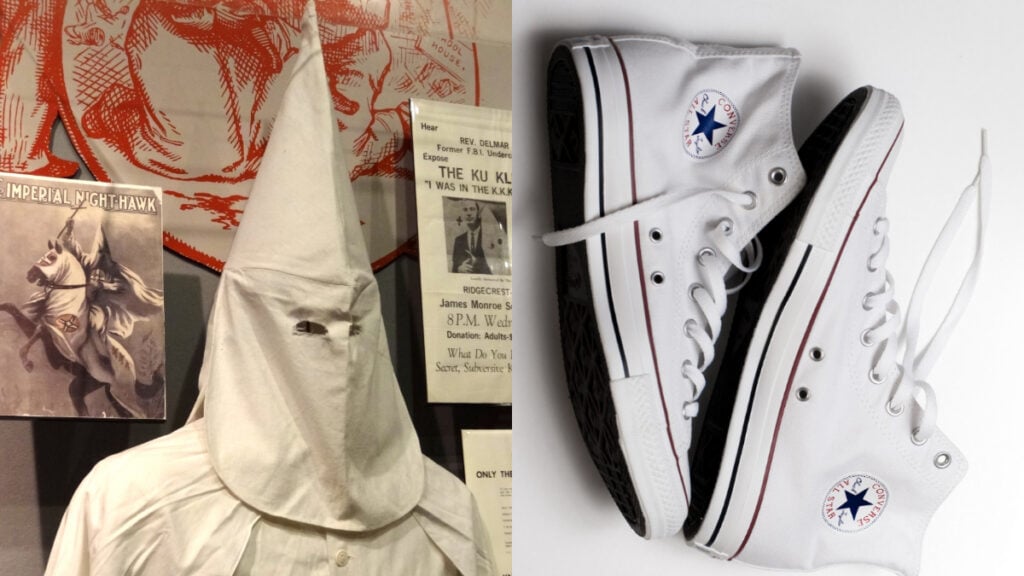
Converse, the once-beloved maker of the Chuck Taylor All-Star sneakers, is facing intense backlash over a promotional image for its Chuck 70 X sneakers after social media users said the advertisement appeared to depict Ku Klux Klan (KKK) imagery alongside the silhouette of a hanging person. Hence, the Massachusetts-based global company had to delete the ad and apologize, though critics remained suspicious.
The image in question was part of the campaign featuring aespa member Karina and shows the K-pop star wearing a flowing white skirt while holding a pair of Converse sneakers. The lighting and composition on the skirt also created a pointed white shape that some viewers said resembles a Klan hood, while the sneakers hanging from Karina’s hand can appear like dangling feet.
The campaign was posted on Converse’s social media accounts on Sept. 3, weeks after the Chuck 70 X was released globally on Aug. 27. As the image spread online, critics questioned how it made it through the brand’s creative and approval process.
Actress Yvette Nicole Brown was among those who reacted publicly, asking on Threads, “That’s a lynching, yes?” Photographer Stephanie Schwartz similarly argued that the image’s “shadow, light, and composition” made it difficult to believe the resemblance was simply accidental. Converse subsequently removed the image from several social media accounts and websites and issued an apology.
“We’re sorry. We understand why this image is deeply upsetting and recognize that we got this wrong,” the company said. They also added, “We removed it from our channels and are working to remove it everywhere it appeared. This should not have happened and we will do better.”
People online doubt it was accidental
The controversy also brought attention to another Converse campaign created with Danish lifestyle brand Palmes. That image shows a man on a ladder holding sneakers near a tree, prompting some users to argue that the separate visual made the backlash surrounding the Karina advertisement even more troubling.
Social media reaction has been sharply divided. One commenter wrote, “I legit thought I was looking at a KKK hood before I even read anything,” while another added, “And the feet of a ‘hanging’ person.” A separate user said, “I had to stop mid scroll because I thought it was a hanging.”
Others questioned whether the interpretation was fair. One commenter admitted they initially saw only the Converse star and later understood the comparison after others pointed it out. Another wrote, “Whether or not it was meant to be racist, it’s [expletive] marketing.”

That disagreement has fueled a larger question over whether the imagery was an intentional provocation or an unfortunate failure to recognize how the composition could be interpreted. One commenter pointed out, “I also work in marketing and have noticed the trend of racist ads from big companies it’s always intentional” with another responding, “What sells, generates publicity? ‘Accidental Racism’. Next thing you know sales climb, then plateau back to normal. Rinse and repeat. It’s been Target’s business marketing model for years.”
There is currently no public evidence establishing that Converse deliberately intended to reference the KKK or lynching. For critics, however, the central issue is not necessarily what the designers intended. It is how an image with such disturbing associations reached a global advertising campaign in the first place.