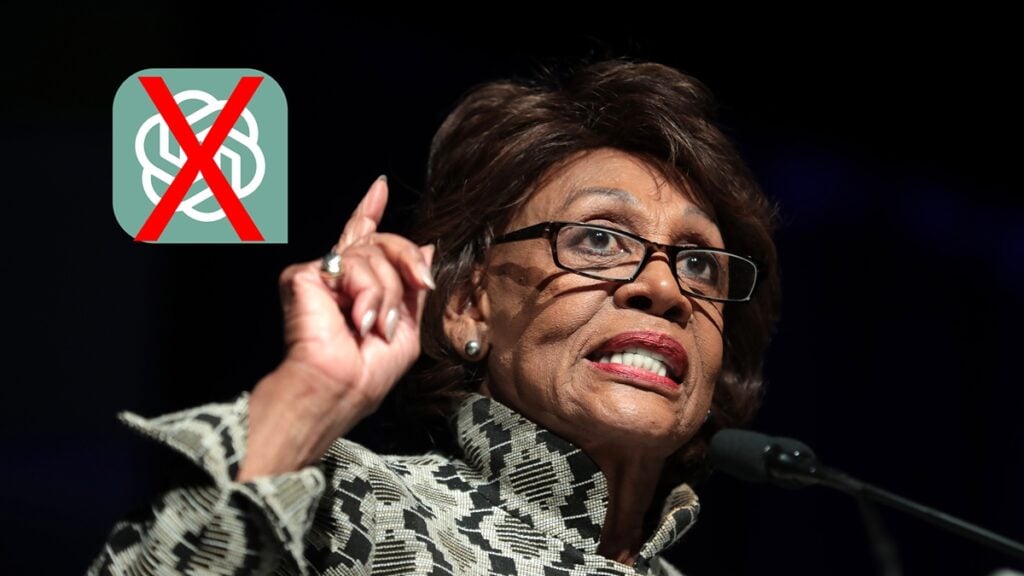
California Rep. Maxine Waters is leading the fight against potential government bailouts for struggling artificial intelligence (AI) companies, arguing that tech billionaires should face the consequences of their own risky investments rather than expect American taxpayers to rescue them. Her push comes amid growing fears that the US AI boom could follow China’s trajectory, where a spectacular stock market rally has already given way to a $480 billion wipeout as investor confidence falters.
The 88-year-old Democrat joined forces with Congressional Progressive Caucus Chair Greg Casar (D-TX) on October 29 to introduce a resolution opposing federal financial assistance for artificial intelligence companies that collapse if the industry’s booming market turns into a bubble.
Instead, the lawmakers want the federal government to prioritize workers, retirees, and low-income families who could suffer the consequences of an economic downturn. “If it all comes crashing down they should not expect taxpayers to rescue them,” Waters said in a statement. “The American people should never again be forced to foot the bill for billionaires’ reckless bets.”
The resolution also draws comparisons with the 2008 financial crisis, when the government stepped in to rescue major financial institutions following widespread risky lending and investment practices. While banks received enormous amounts of government assistance, millions of Americans lost their homes, jobs, and retirement savings. Waters and her fellow Democrats argue that the same scenario must not happen if the AI industry experiences a similar collapse.
Too Much Risk-Taking From Tech Giants
The lawmakers warn that AI-related companies collectively hold trillions of dollars in debt, much of it raised through opaque and largely unregulated private credit markets. They also point to soaring stock valuations and insufficient federal oversight as reasons for concern. Under the proposed resolution, lawmakers would oppose emergency loans, direct capital injections, and other special assistance designed to keep insolvent AI companies afloat.
It also calls for executives responsible for reckless or illegal corporate behavior to face civil and criminal accountability rather than walk away with lucrative golden parachutes. Instead, federal assistance should support ordinary Americans through unemployment benefits, housing assistance, food programs, job creation, and protections for pension and retirement savings.
The proposal has attracted considerable support on social media, with commenters largely welcoming Waters’ position. “Billionaires can bail themselves out. Bootstraps, remember?” one person wrote. Another questioned the possibility of government assistance for wealthy corporations, commenting, “Isn’t that called capitalism? Bailouts are called SOCIALISM,” with another echoing, “Isnt that like corporate socialism?”

Others were more skeptical about whether the resolution would gain traction in Congress. “It’ll never pass because look at who owns both the AI companies and Congress, but good on her for making the right noises,” one person wrote. Another questioned why lawmakers were only proposing the measure, commenting, “Don’t propose it, demand it! Do your jobs!”
The resolution has been endorsed by several organizations, including the American Federation of Teachers, Americans for Financial Reform, and Social Security Works. Whether the proposal advances remains to be seen, but Waters’ message is clear: if AI companies want to reap the rewards of their investments, they should also be prepared to absorb the losses.