A Catholic woman in Kentucky was slammed online after she complained about a school displaying verses from the Quran.
In a Facebook post attributed to the woman, she expressed concern over the Islamic display at the school, drawing a connection between it and socialism. “I’m writing this as a Catholic mother and as someone whose family knows firsthand what socialism does to people of faith,” she wrote.
The woman said that she and her daughter attended an open house at Assumption High School. According to her, her daughter asked whether she had noticed a poster displayed inside the school, which the mother claimed she had already seen.
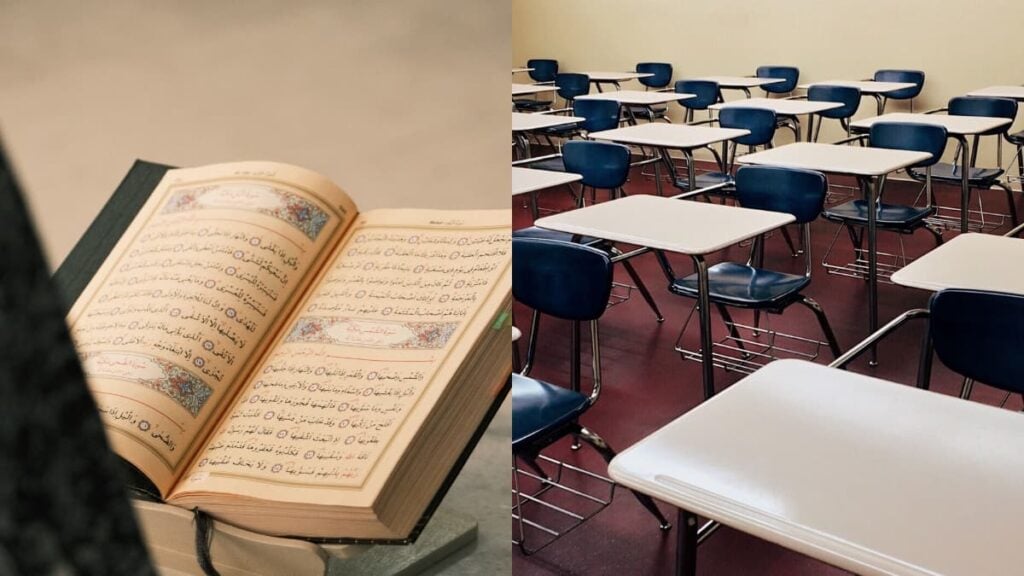
She explained that she was already “torn up” after noticing a wall featuring Islamic writing. She clarified that the display did not simply contain Arabic text but also included verses from the Quran. The mother then made a remark that critics could interpret as Islamophobic, writing, “talking about Islam as religion like if it something to be proud of.”
The woman continued criticizing the Islamic display, explaining that she had invested thousands of dollars in her children’s Catholic education. “Because l believed they would be formed in our faith there, safe from indoctrination. So I was deeply disheartened to see the school showcase socialist leaders and Islamist figures as role models for our young women,” she wrote.
The woman continued her post by drawing comparisons between Islam and socialism. She claimed that socialism had persecuted the Catholic Church wherever it gained power. This includes Cuba, which her family had fled. She also made another remark that critics could interpret as Islamophobic. That was when she referred to Christians around the world who have been killed for their faith by Muslim extremists.
The mother went on to criticize the school for displaying Islamic religious content. “a of innocent martyrs deserve better than a Catholic school holding up the ideologies that persecuted them as examples to follow,” she added.
She concluded her post by expressing disappointment in the school. “I understand Assumption is a business and opens its doors to everyone. But it is a Catholic school first, and in this it has failed failed our faith, and failed the memory of those who died for it. Our daughters deserve better role models than this,” she wrote.
The woman faced criticism online over her post. Critics accused her of intolerance toward Islam. They questioned why she was so upset about students being exposed to another religion. Some argued that displaying verses from the Quran or educating students about Islam does not necessarily mean that a school is promoting the religion or encouraging students to abandon their Christian beliefs.
The controversy also raised questions about religious freedom in America. This is especially since the First Amendment protects the right to practice different religions, including Christianity and Islam. Although Assumption High School is a private Catholic institution with its own religious identity, critics argued that acknowledging other faiths should not automatically be viewed as a threat to Catholic education.
Viewers Slam Catholic Kentucky Woman Over Post
Many people online criticized the Kentucky Catholic woman over her post, accusing her of expressing racist and intolerant views. “When the private school isn’t racist enough…,” one person joked. Another mocked her reaction by commenting, “‘They were using ARABIC NUMERALS in the math class!’”

Others continued criticizing the woman, with some questioning her concerns about religious indoctrination at a Catholic school. “… Safe from indoctrination… At a Catholic school? Do people not have self awareness at all anymore?” one person commented. Another defended the teaching of different religions in Catholic schools. “All faiths are accepted at Catholic High Schools as far as we know. My son goes to St X and in World Religion they are learning about all the different types. Maybe she better home school,” they wrote.
The post raised broader questions about religious tolerance and why some people object to Islam being represented or practiced in certain spaces. It also prompted discussions about whether those who advocate for the visibility of their own faith while opposing the representation of others should face criticism for what some consider a double standard.