
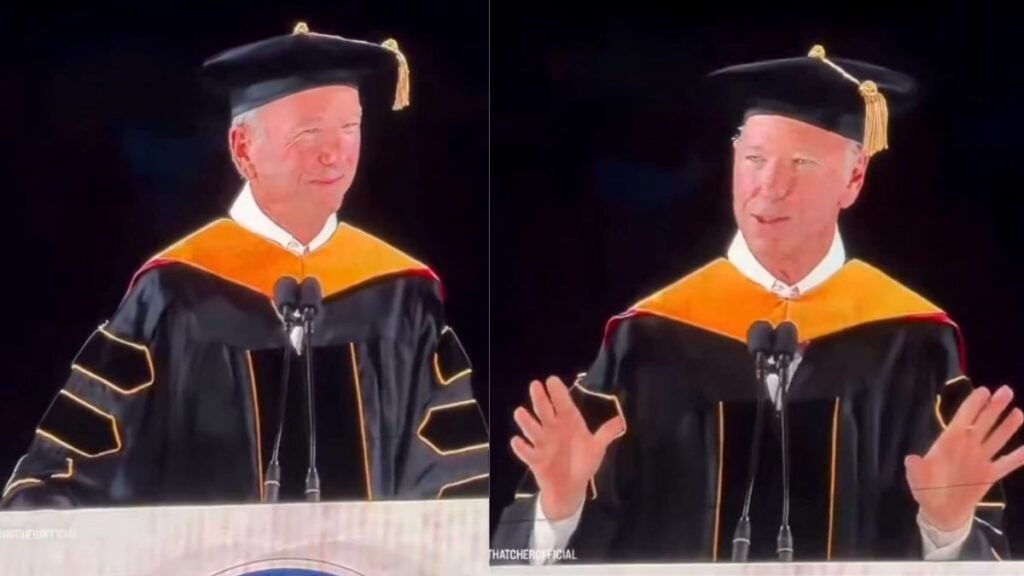
Eric Schmidt, Google’s former CEO, walked onto the graduation stage at the University of Arizona on May 16, 2026. He faced a crowd that spent weeks protesting his appearance, and you could hear their disapproval throughout his whole speech. Whenever Schmidt talked about artificial intelligence and automation, students booed. Meanwhile, other speakers got cheers and applause.
During Schmidt’s address, the crowd clapped only twice. When he brought up AI and data centers, the booing got even louder. He didn’t ignore it. Standing at the podium, Schmidt said, “I know what many of you are feeling about that. I can hear you. There is a fear.”
Video confirmed he spoke through constant shouting from the audience as soon as he started. Schmidt pushed ahead anyway.
He compared AI’s impact to how immigrants helped build society, told grads, “when someone offers you a seat on a rocket ship, you do not ask which seat – you just get on,” and spoke directly to the crowd’s worries: “There is a fear in your generation that the future has already been written, that the machines are coming, that the jobs are evaporating, that the climate is breaking, that politics are fractured, and that you are inheriting a mess that you did not create.”
He admitted those fears were reasonable, but told graduates to get involved and help steer the direction of technology. Whenever the booing peaked, Schmidt referenced the importance of free expression. He stayed until he finished his remarks.
Viral Graduation Moment Sparks Debate Over Eric Schmidt
The generational framing landed first. “It’s always the boomers who aren’t going to have to live through the effects of AI,” one person wrote. Another read the room differently: “The younger generation is scared for their future because they think AI will make them useless and redundant. They are scared that all their time and efforts spent acquiring an academic education will be wasted. Can’t blame them.”
Schmidt’s delivery drew its own commentary. “Such a manipulative creep, trying to conflate artificial codes with actual real human beings: immigrants. And his smug sneers are infuriating. The entitlement to continue his pablum with such arrogance while being booed!” one commenter wrote. Another saw something more calculated behind it: “Every time he smirks, just remember that he is laughing inside knowing that a lot of us are currently powerless in their venture for AI.”
Some pushed back on the graduates themselves. “Americans have to come to terms with the fact that they need to compete with a global workforce who studies hard science, works longer hours, and is paid less. No amount of booing will change that. Eric Schmidt is not their problem.” But for others, the reaction itself was the point: “The fact that they kept booing the whole time is a good sign. This younger generation is fearless, and that’s the energy that is needed to finally break this corrupt system.”
The University of Arizona stood by its choice. Spokesperson Mitch Zak said Schmidt was invited because of his “extraordinary leadership and global contributions in technology, innovation, and scientific advancement.” Just last week, Nvidia CEO Jensen Huang spoke at Carnegie Mellon, painting a much brighter picture. He said AI would give young people more chances to shape their own futures. Huang got a very different, more welcoming response.