
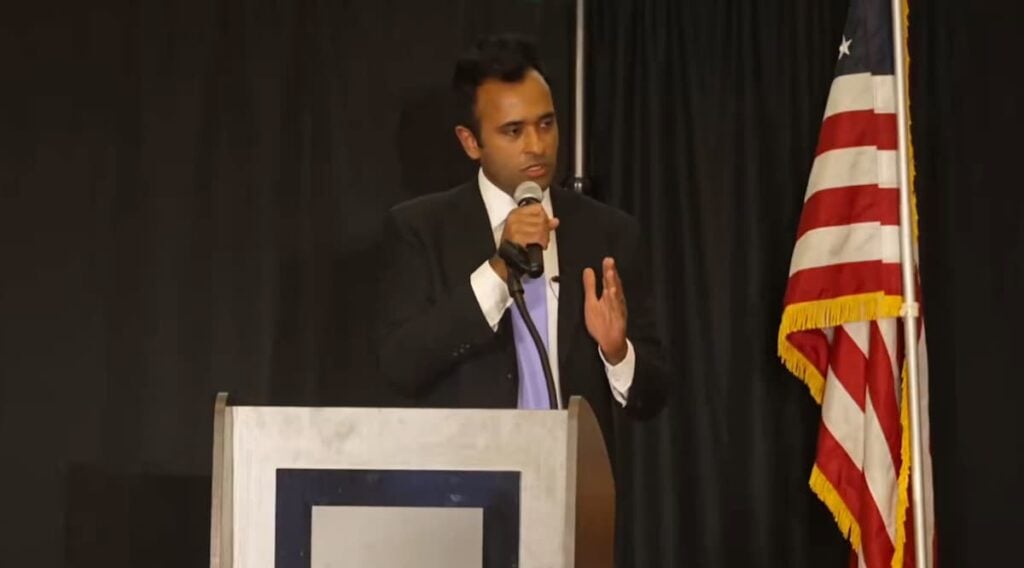
Republican gubernatorial nominee Vivek Ramaswamy is facing growing backlash across Ohio as residents push back against his plan to transform the Ohio River Valley into a national hub for artificial intelligence data centers.
The debate intensified after a new Gallup poll found that 71 percent of Americans oppose building AI data centers in their local communities. In Ohio, where nearly 200 data centers already operate, frustration is turning into organized resistance.
Ramaswamy has repeatedly promised to make the “Ohio River Valley” the next “Silicon Valley,” arguing that AI infrastructure, semiconductor investment, Bitcoin mining, and expanded energy production could reshape the state’s economy. But many Ohioans believe the plan would benefit corporations and investors far more than the communities expected to host the facilities.
In the Ohio subreddit, residents reacted sharply to news of the expansion push. One commenter wrote, “Vivek wants to turn the Ohio Valley into the next Silicon Valley. Ask him what good that does for you.”
Others pointed to fears over rising utility costs, environmental strain, and limited long-term employment opportunities.
A single data center raises electric bills, uses massive amounts of water, and creates very few permanent jobs, one user argued during the discussion.
Rural Ohio Organizes Against Data Centers
The backlash is no longer confined to social media. Residents in Adams and Brown counties have launched a statewide ballot initiative to ban the construction of large-scale data centers that consume more than 25 megawatts of power. Organizers are now racing to collect enough signatures to place the constitutional amendment on Ohio’s November ballot.
The movement reflects growing concern that rural communities are being asked to absorb the environmental and economic costs of an industry many believe offers little in return.
Critics frequently cite reports showing hyperscale data centers can consume electricity equal to tens of thousands of homes while employing relatively small permanent staffs once construction ends. Water usage has also become a flashpoint, particularly in central Ohio where future shortages are already projected.

Online, frustration has increasingly focused on the belief that ordinary Ohioans are being sidelined while wealthy investors profit.
“Ohioans do not want data centers. He doesn’t get it,” one Reddit user wrote.
Another added, “None of this helps the average American.”
The issue could become one of the defining fights of Ohio’s 2026 governor’s race as Ramaswamy faces Democrat Amy Acton in what early polling suggests may be a highly competitive election.