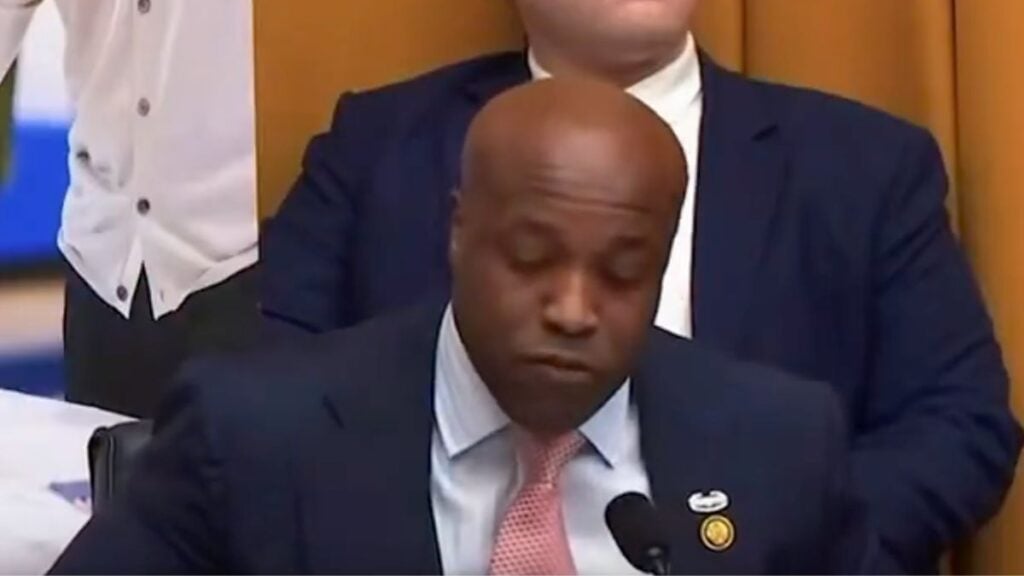
Texas Rep. Wesley Hunt grabbed attention at a congressional hearing this week by sharing his father’s experiences with segregation in the Jim Crow South. He used the story to push back against the idea that requiring photo ID to vote is some kind of new racial oppression.
Hunt’s speech came during a House Judiciary Committee hearing about the Southern Poverty Law Center, but his comments on voter ID and race went viral, sparking a fresh round of debate online.
During the hearing, Hunt turned to his Democratic colleagues, some of whom had compared today’s voting policies to Jim Crow laws. The hearing itself was supposed to focus on the SPLC and questions about the group, but Hunt took center stage.
He accused Democrats and the SPLC of recycling old racist tropes that he believes are outdated.
Seated next to a poster that showed images from Jim Crow days alongside a photo of someone presenting an ID at the polls, Hunt zeroed in on his family’s history. “My own father, who grew up in a segregated South, had to walk around to the back of a restaurant just to order a sandwich because of the color of his skin,” he said.
That, he insisted, was Jim Crow. So he takes offense at comparing it to modern ID laws.
The Texas congressman went further, saying the comparison stirs up unnecessary racial tension for political gain. Hunt argued that voter ID is a basic standard, one that applies to everyone, no matter their race.
He rattled off examples: flying, cashing a check, buying alcohol, entering federal buildings – places where ID is required, and nobody complains about oppression. In his closing remarks, Hunt called the “Jim Crow 2.0” rhetoric pure political “theater.” He argued Democrats focus on creating grievances instead of solving real problems.
“It’s not oppression. It’s not segregation. It’s not racism,” Hunt said.
Internet Reacts To Texas Rep. Wesley Hunt’s Jim Crow Voter ID Speech
Reactions online split sharply, with some viewers praising Hunt’s framing as a necessary correction and others dismissing it as political cover for policies they see as harmful.
Several commenters were enthusiastic in their support and saw Hunt as delivering a message they felt was overdue. “He presented phenomenal analogies, illustrations, and delivered a very powerful message to all people,” one person wrote, while another added, “He is a true champion for black people. He wants to pull them away from the constant brainwashing of oppression and racism claims and build them up to become successful in their own right.”
Others pushed back on Hunt’s framing without rejecting the underlying point about ID entirely. “It’s not the ID part,” one commenter wrote. “It”s the buying a passport to prove you’re a citizen when your regular ID isn’t sufficient. I have no problem showing my real ID to vote, but a big problem with having to use a passport ($60-$100) AND the time frame it takes to receive it.”
Some commenters went in a sharply different direction, questioning Hunt’s motives and framing his position as a betrayal. “Even black people are in Trump’s cult,” one person wrote. “These are the very worst people because they don’t believe in supporting their own kind.”
Others turned their attention to the broader political stakes: “Democrats would lose overwhelmingly if they were no longer allowed to cheat election results,” one commenter said. And one commenter offered a generational reframe: “That was like 60 years ago. We are not that America. But Democrats want to drag us back to those times.”
Hunt is 44, from Texas, and won’t return to Congress after January 2027 because he lost his Senate bid. He has spoken before about being a direct descendant of enslaved people, with a great-great-grandfather born on a plantation. Hunt mentioned the SAVE America Act, backed by President Trump, which would require proof of citizenship to vote in federal elections.
It’s a key part of the voter ID debate. But the bigger question — whether today’s voter ID rules burden lower-income voters or communities of color more than others — still isn’t settled.