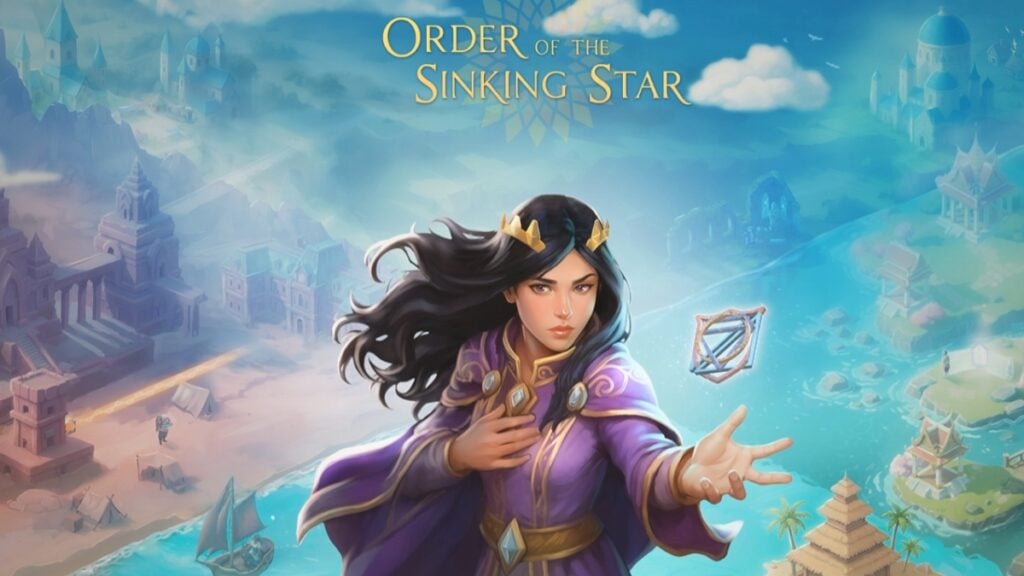
Order of the Sinking Star is the upcoming narrative puzzle experience created by Jonathan Blow, creator of Braid and The Witness. With a legacy of all-time classic games that have influenced the genre, he took the time to answer some questions about legacy, the North Star of his design philosophy, and trying to make something that captures the modern audience.
The Nerd Stash Senior Writer, Julio La Pine: Following the massive success of The Witness, what inspired the specific direction of Order of the Sinking Star? Are there any mechanics or concepts that didn’t quite fit into The Witness that finally found a home here?
Jonathan Blow – Creator of Order of the Sinking Star: One of the most interesting design elements of The Witness, for me, was the way that the individual puzzle shapes are pre-designed so that they interact with each other in interesting ways, later on when you get to more-complex puzzles; and part of what makes this enjoyable is that you probably didn’t foresee the interactions when you were first figuring out the puzzle symbols, even though, once you see the interactions, they feel natural.
With this game, I wanted to take this kind of experiment to a much bigger scale: what if, instead of combining relatively simple puzzle symbols that have just a few rules, we start with entire games that are already something interesting and that people would enjoy playing, and then combine *those*? Well, it took a lot of development time to find the answer, but I am very happy with where we got to.
TNS: In an industry that is increasingly leaning toward fast-paced, high-action experiences, how challenging was it to balance a methodical puzzle-adventure with modern player expectations and gaming staples?
Jonathan: I think a designer has to realize that there are going to be people who want to play puzzle games, and people who don’t. And if you bend over backward to try and design a game for ‘everyone’, by bending it away from what the puzzle players want, and bending it more toward what you think the non-puzzle-players would want, you end up with something mediocre that’s not good for anyone.
So, my approach here has just always been to work hard to make the best puzzle game possible. If we can make the game more friendly to mainstream players in a way that does not compromise its core, then that’s great, and we are always looking for those opportunities. But what sets our games apart is that we are not pandering, and players see that and appreciate that.
TNS: When blending story and logic, what is your “North Star” during the design process? Do you build the narrative around the puzzles, or do the puzzles emerge from the needs of the story?
Jonathan: In this game (and in both Braid and The Witness), the puzzles came first, and then I am always trying to figure out the story and world-building that amplifies the interestingness of playing the puzzles. This isn’t easy, and what it entails changes from game to game.
In Order of the Sinking Star, it’s very important that the story themes echo the gameplay themes and are in relation to them at all times. For example, we have a world with magic mirrors; these mirrors can evoke ideas of introspection, or of transporting yourself to a nearby place that is related to where you are now, or just the motif of diagonalness and things being diagonal to each other (which arises directly from the way the mirrors work – hard to explain outside the game!) Then I build the story elements around these ideas, so they always at least feel like they are working with the game, and are tied together in a fundamental way.
This use of puzzle motifs to drive fiction might sound strange but it’s been done a fair amount in certain corners of literature, for example, in Italo Calvino’s book Invisible Cities, which was also a big inspiration for Braid.
TNS: The puzzle genre has seen a bit of a renaissance recently. Do you draw inspiration from other contemporary titles, or do you prefer to work in a “creative vacuum” to ensure your vision remains distinct?
Jonathan: The thing is, I started this game 10 years ago, and from the very beginning, there were way more ideas than we could possibly do, so it’s been plowing ahead on its own path and is not much influenced by recent games. Part of the reason for this is that I see tremendous depth in the puzzle space that we mostly haven’t been tapping, and I think players will be interested to see what that looks like.
TNS: You’ve built a dedicated following over the years. Do you have a specific message for the fans who have been with you since Braid and are now preparing to dive into Order of the Sinking Star?
Jonathan: Order of the Sinking Star is a huge and very complex game, and we just wouldn’t be able to make things of this scale without the players out there supporting us. We design our games for players who are smart and take initiative to figure things out, and every time we release something, I am just presuming/hoping that there are enough people out there who appreciate this and want to play that kind of thing. So far, there always have been, so to the players I want to say, thanks for being you.
If you’re a fan of puzzle titles, Order of the Sinking Star is taking things several steps further by providing more than only a handful of puzzles; it is bringing more than 1,000 of them, and all in an interconnected way. So, if you want to get your hands on this unique experience as soon as it launches, make sure to wishlist it and keep an eye out for any future updates.