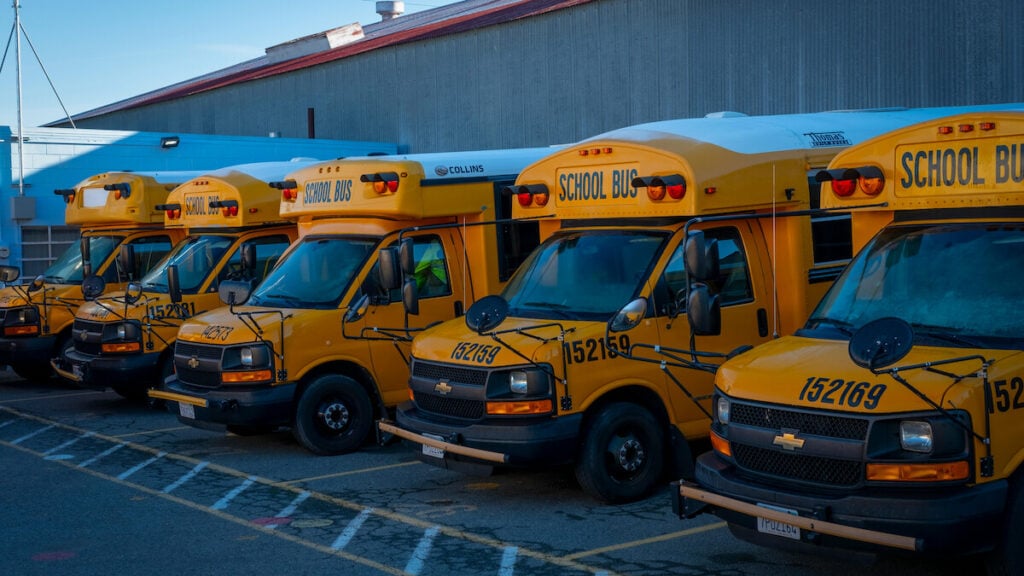
An Ohio state workgroup draft report found that school districts declared roughly 22,000 students too “impractical” to transport during the current school year. About 21,000 of those students attend private schools, leaving more than a third of Ohio’s private school population without guaranteed transportation.
According to cleveland.com, a 1965 Ohio law requires public school districts to transport many charter and private school students living within district boundaries. However, districts can also declare students impractical to transport based on factors such as cost, distance, route efficiency, and available alternatives.
When districts deny transportation, families receive cash payments known as Payments in Lieu of Transportation (PILO) instead of access to school buses. The report concluded that those payments often fail to cover the actual transportation costs faced by working families.
The transportation crisis has intensified as districts face rising operational expenses and ongoing bus driver shortages. State transportation costs increased nearly 5% this school year to roughly $1,273 per student. Many districts also continue to struggle to maintain routes due to staffing shortages.
The Ohio Pupil Transportation Workgroup is proposing regional transportation systems. The proposal would allow public districts, private schools, charter schools, and educational service centers to coordinate busing networks together. Additional recommendations include fully funding transportation costs and allowing transportation funding to follow students regardless of school type.
The debate has also exposed growing political divisions over whether public school districts should continue absorbing transportation costs tied to private education systems.
Piet van Lier, deputy director of Honesty for Ohio Education, argued the mandate places unsustainable burdens on public schools.
“If you want to provide busing for private school students, pay for it and have them bus them,” van Lier said. “They already have a separate school system; they should have a separate busing system too.”
Tom Rhatican of the Catholic Conference of Ohio defended the transportation requirements, citing survey data showing transportation cuts have directly contributed to enrollment declines among private and charter schools.
State Sen. Andrew Brenner, a Delaware County Republican and member of the transportation workgroup, also acknowledged receiving complaints from Catholic families whose children lost transportation access.
The report additionally found that 119 out of 280 school districts declared it impractical to transport every eligible private school student, refusing to provide busing services entirely.
Ohio Districts Struggle with Rising Transportation Costs
“Urban Public School systems are being bankrupted by laws that say it is their responsibility to provide transportation to every private school kid to get from whatever point A to whatever point B they need,” one community member wrote.
Another resident pointed to what they viewed as unequal treatment within the same district. “This past year my son had no bus to his public school 1.9 miles away,” the commenter stated. “However, the neighbor kid was provided a bus by the same district to his private, religious school that is 8.8 miles away.”
Other residents accused state officials of undermining public education through transportation mandates tied to private schools. One commenter claimed officials were “actively trying to destroy the public school system.”
Several parents also focused on the impact transportation cuts are having on struggling families. “The fact that 22k students are just getting told ‘figure it out yourself’ while their families might not have the means is the kind of thing that widens the opportunity gap real fast,” one commenter argued.
Not every reaction opposed the current transportation system entirely. Some residents argued transportation access should remain available to all students regardless of school type.
“I think that society should provide transportation to school for all kids,” one resident wrote. “I don’t think that public schools should be under any obligation to transport charter school or private school students.”
Another commenter defended public transit alternatives, writing, “In New York City, most kids either walk or take public transit to school.”
It remains unclear whether Ohio lawmakers will adopt the workgroup’s proposal to move student transportation into regional transit networks.