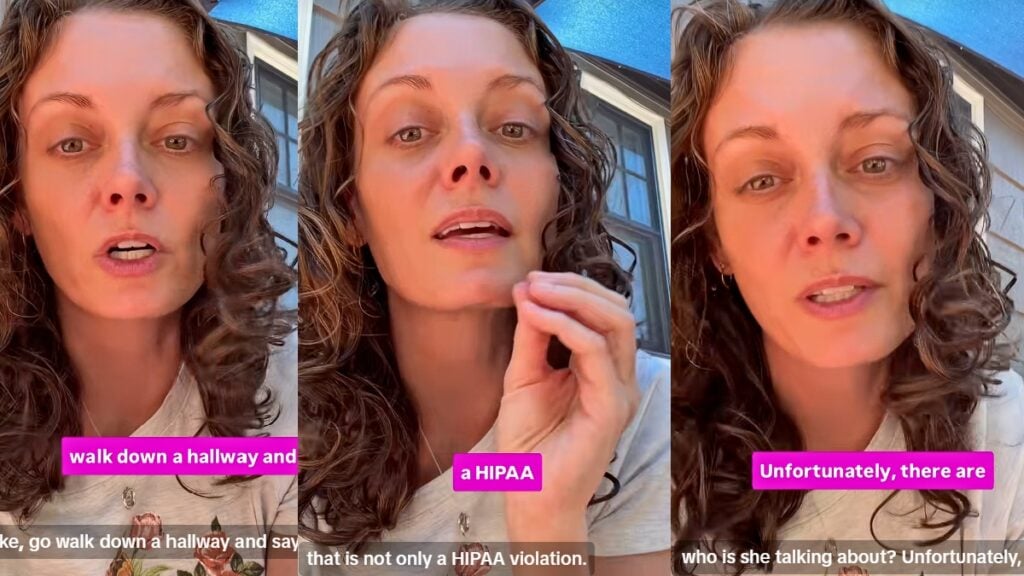
An Oregon doctor is calling out healthcare workers who share details about their patients in “day in the life” videos, warning that some creators may reveal enough information for viewers to figure out who they’re talking about. She argues the trend isn’t just a privacy concern but could make already-anxious patients afraid to seek medical care.
The Oregon doctor specifically addresses medical workers “who film at work” and discuss the procedure they allegedly just did. She argues that sharing enough specific details about a patient’s care could violate HIPAA, pointing to information such as the provider, date, and workplace that could potentially make a patient identifiable. “It’s you, it’s that date, it’s where you work,” she says.
Some healthcare creators claim the stories they tell are fictionalized, but the Oregon doctor argues viewers have no way of knowing that. Instead, she worries patients could watch a provider’s videos and wonder, “Oh, this doctor: I’m their content.”
She acknowledges that the situation is different when a patient has explicitly consented to having their information shared. Her concern instead centers on healthcare workers discussing encounters without the patient’s knowledge or permission. However, there are unfortunately so many healthcare workers on TikTok that allegedly overshare. One example the Oregon doctor uses is of a midwife: “The amount of details she shared was like a sign-out report.” She claims patients are already deciding not to get medical help. So seeing their private information as content could keep them from needed treatment.
For Lincoln, the bigger concern is what these videos could do to patients’ trust in healthcare providers. “If they’re worried that you’re going to make a day in the life about them without their consent, that’s another reason [patients] may avoid us,” she argues.
Patients Say Healthcare TikToks Are Making Them Anxious
Several believe she has a point, and that social media creation has gotten out of control. One says, “I think nurses need to stop doing this as well. It’s so out of control that people are terrified to get medical care.” Another argues that healthcare workers don’t want to hear they’re doing something wrong. They state, “This app is FILLED with HIPAA violations, but if you try to tell them, you get dragged.” One commenter points out that there are also other violations of privacy, simply stating, “And: Stop. Filming. In. Surgery.”
Meanwhile, several admit that if they knew their provider was posting about them, they’d stop going to the doctor. One states, “The worst days of my life being monetized for someone else’s gain would break me.” Another agrees, “If I saw a video from a doctor talking about one of the worst days of my life, I would truly never seek medical attention again.” One commenter states they have avoided going to the dentist “because of all the people making fun of dental patients on social media.”
Lincoln emphasized that simply leaving a patient’s name out of a video does not necessarily mean their privacy is protected. She argues that combining details such as when and where someone received treatment with information about their medical care could make some patients identifiable, which is exactly why she believes healthcare workers should think twice before turning their workday into content.