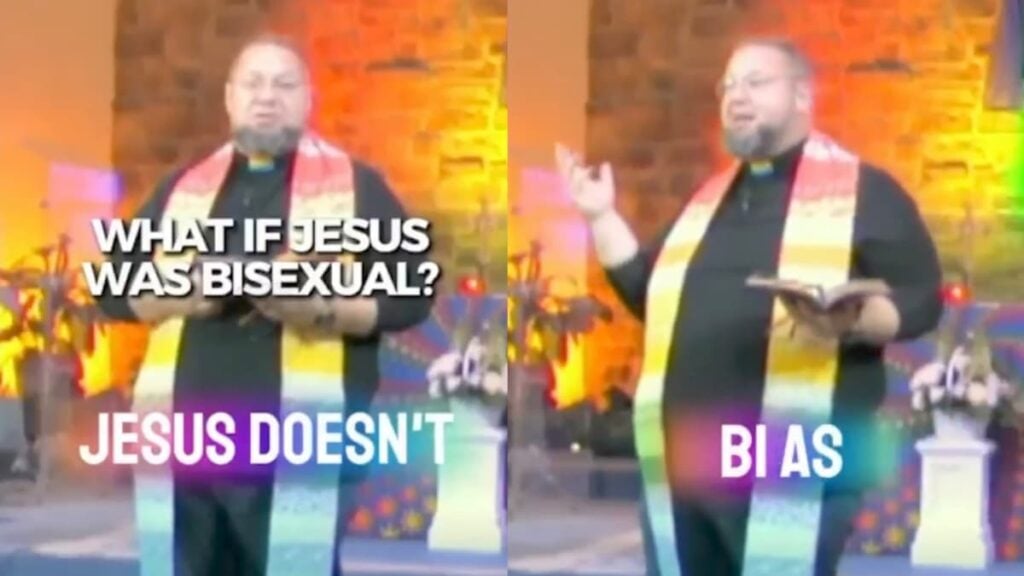
Outrage erupted online after a queer pastor in Florida shared his belief that Jesus was bisexual during a public discussion, sparking widespread debate on social media.
A video of the pastor making the controversial claim was shared across social media. In the clip, Mark A. Ferriera appeared to be preaching while wearing a rainbow colored scarf. During his remarks, he said that Jesus did not have “a wife or a husband that we know about.”
The pastor then went on to speculate that Jesus may have been bisexual. He said that he “personally likes the idea” that Jesus might have been married. He also said that he liked the idea that Jesus may have had “a nice close relationship” with Lazarus.
“Who knows? It’s not defined,” the pastor said in reference to Jesus’ relationships. The video ended with him asking whether he could say during his sermon that he had always thought Jesus was bisexual. He also claimed that he was not the first person to express that view. His remarks quickly sparked backlash online.
Viewers Left Furious After Florida Pastor’s Shocking Claim
The video sparked reactions online. Many viewers were outraged after hearing the Florida pastor’s comments about Jesus. They argued that his statements were unsupported by scripture and inappropriate for someone serving as a pastor. “That’s neither a pastor nor a church… it’s a cult!” one person wrote. Another commenter said, “Facts don’t actually matter to these people. Their minds are poisoned by hatred, ignorance, daddy issues, and Marxism.”
More people criticized the pastor following the viral video and accused him of misrepresenting Christianity. “Not a real church, not a real pastor. Grifter. They do this to openly mock and demean Christianity by taking advantage of the very loose laws regarding forming a church and exploit the tax advantages/shelter. Trash LGBTQ behavior abusing the system,” one person wrote. Another commenter said, “‘Queer’ pastor is the giveaway. Not sure what he is a ‘pastor’ of, but I would not want to be in his shoes. Blasphemy, blasphemy, blasphemy!”
The video sparked a conversation about the responsibilities of religious leaders and how their interpretations of scripture can generate strong reactions. It also led to broader discussions about the limits of personal theological opinions, with many arguing that controversial claims should have a clear basis in religious texts.