Since allegations of daycare fraud in Minnesota began circulating, Somali communities have faced a noticeable increase in racist harassment. Unfortunately, some individuals have taken it upon themselves to target Somali people in an effort to make them look bad.
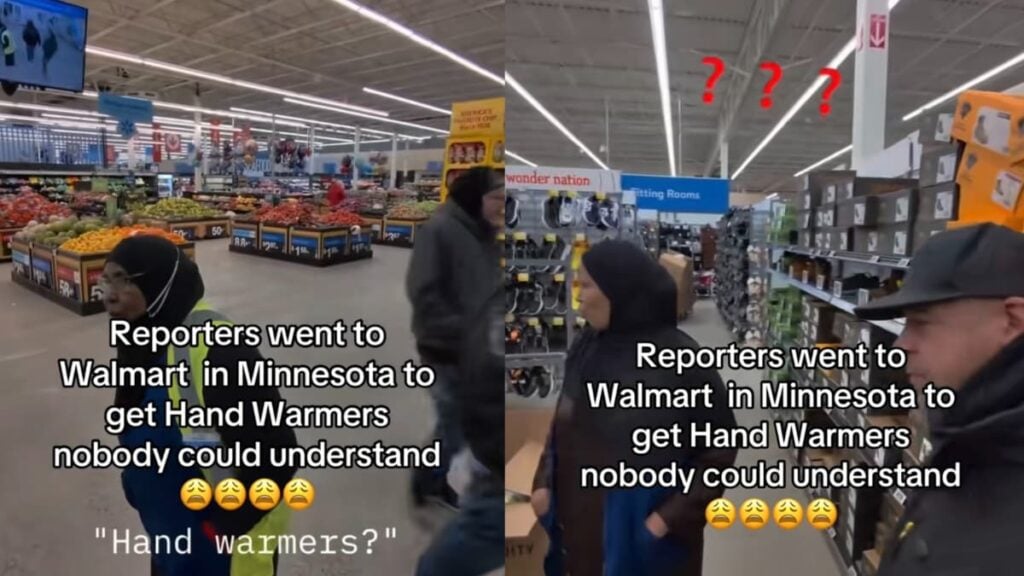
In one short video that circulated online, people claiming to be “reporters” filmed inside a Walmart location where many of the employees appeared to be Somali. The video showed them approaching a Somali female worker and asking her for hand warmers. She responded with what sounded like confusion, saying something along the lines of “I don’t know hand.”
The situation escalated when the worker misunderstood the request and appeared to think they were asking for chicken instead. The interaction was then framed online as evidence that she could not understand English, even though the request itself was unclear and the exchange appeared intentionally confrontational.
Critics of the video argued that it was less about journalism and more about provoking confusion and reinforcing harmful stereotypes. Many pointed out that language barriers are common in customer service settings and that selectively filming such moments only serves to fuel racist narratives rather than inform the public.
The video continued with the men approaching another Somali worker at the same Minnesota Walmart. Once again, they asked for hand warmers. This time, the employee began speaking in a different language, seemingly calling out to another coworker for help. Moments later, another woman, who also appeared to be Somali, came over. She understood what the men were asking and pointed them in the correct direction.
That still didn’t satisfy the men. They moved on to yet another Somali worker and asked her for crayons. At first, she appeared confused and pointed toward the pharmacy area. When they repeated the request, she realized what they meant and responded appropriately.
The men then approached a Somali male employee. One of them stood next to him, waiting for acknowledgment, while the employee remained focused on his phone. It’s worth noting that employees being distracted by their phones is not unique to any one group and happens across all backgrounds.
By the end of the video, the men’s intentions became clearer. They approached another Black man and asked if he worked there. He did not. This final interaction made it apparent that the men were not conducting legitimate reporting but instead selectively approaching Somali and Black individuals in the store in an apparent attempt to provoke confusion and capture footage that fit a predetermined narrative.
Many viewers criticized the video, saying it was less about documenting a real issue and more about targeting a specific community to reinforce negative stereotypes.
People Reacting to the Video of the Somali Workers in Minnesota
Because the video appeared to be filmed with the intent of making Somali workers look bad, the comment section quickly filled with hostility. Many of the responses went beyond criticism and crossed into outright racism. “We would like America back. Thanks,” one person wrote. Another claimed that Somali workers were the reason Americans couldn’t find jobs, saying, “This actually sad… shouldn’t be happening in the US… how many Americans need jobs???”
Others echoed the same sentiment. “And I can’t get a job,” one commenter added, while another wrote, “I can’t believe American citizens are killing themselves to protect this.” One TikTok user summed up their frustration by claiming, “Liberals will unironically say ‘what’s the problem?’ to this.”
Many viewers pushed back against these remarks, pointing out that such comments unfairly targeted an entire community and ignored the reality that Somali Americans are legally allowed to work and are often filling the same frontline jobs as people of all backgrounds. Critics argued that the video and its comment section revealed more about growing xenophobia than about any real workplace issue.
Even more racist remarks appeared under the video as it continued to circulate. One person mocked the workers by writing, “If you need a learning center or healthcare, they would know.” Another added, “I bet they would understand the word goat.” Others escalated the rhetoric further, with comments like, “Minnesota is basically little Afghanistan,” and, “Oh those silly Scamolians.”
Amid the hostility, at least one commenter tried to redirect the conversation in a more constructive way. “Let’s be clear, no one is saying this isn’t a problem. We are saying how they are dealing with it is unconstitutional and inhumane,” they wrote.
For many viewers, the comment section became a clear example of how quickly frustration can turn into open racism. Critics pointed out that targeting an entire community does nothing to address real concerns and only deepens division. Racism, they argued, should never be used as a way to express dissatisfaction or push for change.