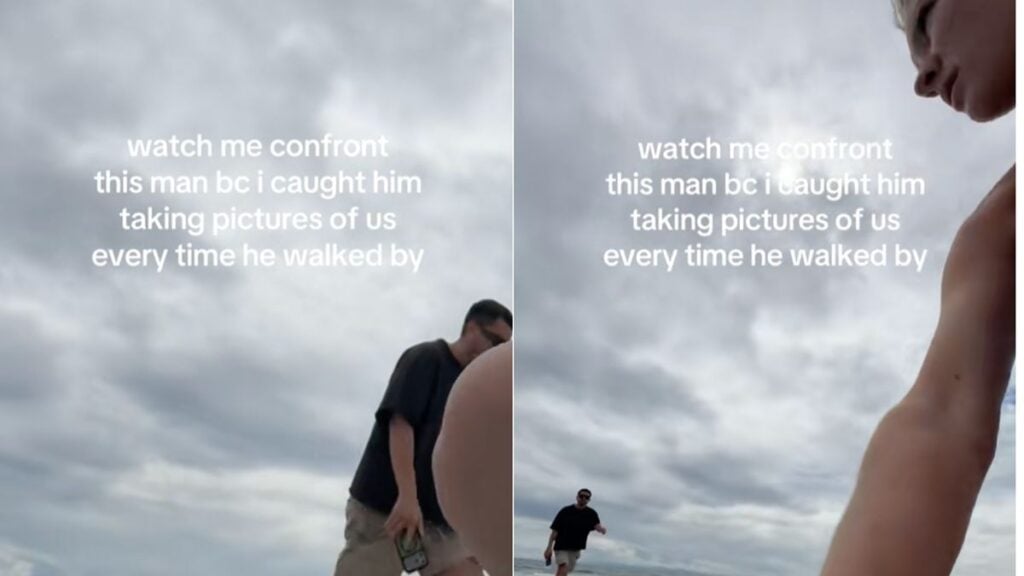
A seemingly ordinary moment at Newport Beach in California has turned into a viral debate after a man was confronted by a group of women who suspected him of secretly taking photos. The incident, shared on TikTok, shows the man casually walking past a group of women while holding his phone by his side, with the camera facing downward. As he passed, one of the women could be heard warning him to make sure he wasn’t taking pictures of people around him.
The situation quickly escalated as the California woman repeated her concern and stood up to confront him more directly. She demanded access to his phone to check his photo gallery, insisting on verifying her suspicions. The man, clearly confused, asked what she was referring to and denied taking any photos. Despite his response, the woman remained unconvinced, labeling the alleged behavior as “disgusting” and arguing that if he had nothing to hide, he should be willing to show his phone. The man, however, did not comply, maintaining that he had done nothing wrong.
Public Users Fire Back at the Approach
After the video was posted online, the women involved in the confrontation faced significant backlash from social media users who criticized their approach. One commenter pointed out what they saw as a contradiction, writing, “Don’t take photos of us, while she takes pictures of him and everyone else. Talk about hypocrites.” Others echoed this sentiment, highlighting what they described as a double standard.
Some users also brought up legal perspectives, noting that public spaces typically come with limited expectations of privacy. One commenter explained, “The problem with this is that according to the law, there’s no expectation of privacy in public. The SCOTUS has actually ruled on this in Katz v United States…😕 So, while it may be invasive, the girls really don’t have a leg to stand on.” Others questioned the practicality of the demand, asking whether anyone would feel comfortable handing over their phone to strangers under similar circumstances. Some even pointed out that attempting to access someone’s phone without consent could lead to legal consequences.

“I don’t like it, but it’s NOT against the law and no worse than videos of people on the streets being posted here daily!” one commenter added, reinforcing the idea that while the situation may feel uncomfortable, it does not necessarily violate any rules. Further criticism centered on the lack of evidence, with users stating that the man was under no obligation to prove his innocence without any concrete proof of wrongdoing.
The California incident has since sparked broader conversations about boundaries, privacy, and behavior in public spaces. While concerns about personal safety are valid, many argue that accusations should be handled carefully to avoid unfairly targeting individuals without clear evidence.