
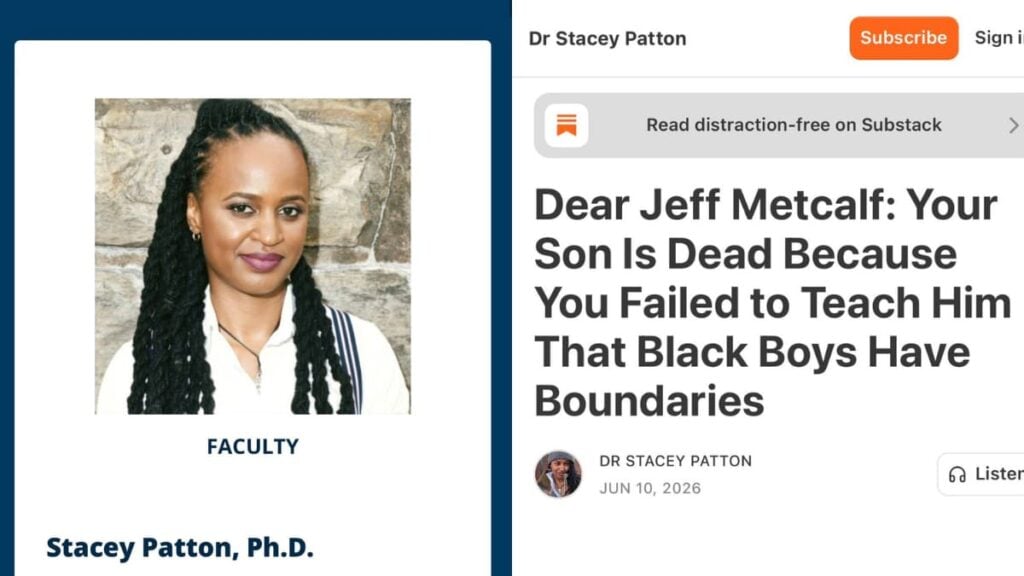
A Black Washington DC professor, Stacey Patton, who is associated with Howard University, has faced backlash online after publishing an article that placed blame on Austin Metcalf’s father in connection with his son’s death.
Patton’s article, published on her Substack, was titled “Dear Jeff Metcalf: Your Son Is Dead Because You Failed to Teach Him That Black Boys Have Boundaries.” The headline and content of the piece quickly circulated online and sparked widespread controversy, with many social media users expressing outrage over its framing and tone.
In her article, Dr. Stacey Patton argues that people should view the circumstances surrounding Austin Metcalf’s death within a broader discussion of race, culture, and upbringing. In the piece, she places significant emphasis on Metcalf’s father, Jeff Metcalf, suggesting that his parenting contributed to the values she describes as entitlement, confrontation, and a lack of respect for boundaries. She argues that these factors, in her view, played a role in shaping the events that ultimately led to the fatal encounter.
One of the article’s most controversial points is her criticism of Jeff Metcalf’s parenting. She argues that he failed to instill what she describes as humility and restraint in Austin Metcalf. Patton also links the case to broader discussions about white masculinity and racial power dynamics in the United States. She also addresses Karmelo Anthony’s behavior during the sentencing hearing, including his refusal to make eye contact with Jeff Metcalf. In the article, she interprets this as an act of resistance rather than disrespect. This is a framing that has contributed to the wider controversy and debate surrounding her writing.
“YOU failed to teach your boy that Black children have boundaries. YOU failed teach humility, restraint, or the sacred fact that another person’s body is not your jurisdiction. YOU failed to teach him that another child’s space is not a challenge to be conquered. YOU failed to teach him that ‘community’ does not mean white boys get to decide who belongs and who does not,” she wrote addressing the father.
She also added, “Austin is dead. Your family is devastated. That matters. Karmelo Anthony is alive but caged inside a racial imagination that had already convicted him. And that matters, too. Two families are shattered. And a whole country is using the tragedy to rehearse the same old script about Black guilt and white innocence.”
Supporters viewed the article as an examination of race, privilege, and accountability in the context of a broader social discussion. Critics accused her of unfairly blaming a grieving father for his son’s death. People also accused her of politicizing the killing of a teenager. They argued that the framing of the piece was inappropriate and inflammatory.
Viewers Criticize Black Washington DC Professor Over Controversial Article
The article sparked reactions online. Many viewers criticized the Washington DC professor over the article she wrote about Jeff and Austin Metcalf. Some also calling for disciplinary action or termination. “They are all like this, it’s digusting. @HowardU you are contributing to the [expletive] in our country by having someone like this on your staff,” one person wrote. Another commented, “Let’s take the professor’s lesson here and apply it to Karmelo’s current situation: He’s in prison because his parents failed to teach him that society has boundaries on murdering people. Huh. Checks out.”

More people expressed outrage online over the article. One person wrote, “Ah ok, so black people have boundaries but when Austin asked to respect his and his team boundaries in their tent, it was ok for Antony to not respect Austin boundaries and stab him in his heart, because…yea, because black peoples have boundaries…WHAT THE [expletive]? She is [expletive].”
The article sparked a broader online conversation about its framing and conclusions. Many people argued that they were inappropriate or inaccurate.It also led to discussions about accountability in cases like this. Many people emphasized that no one should blame parents of victims for tragedies involving their children. This is regardless of broader social or cultural debates surrounding the case.